- Contact Us
- -
- Payment
- -
- 中文版
Knowledge Center · 2026-09-21 09:36:50 · 8 hits
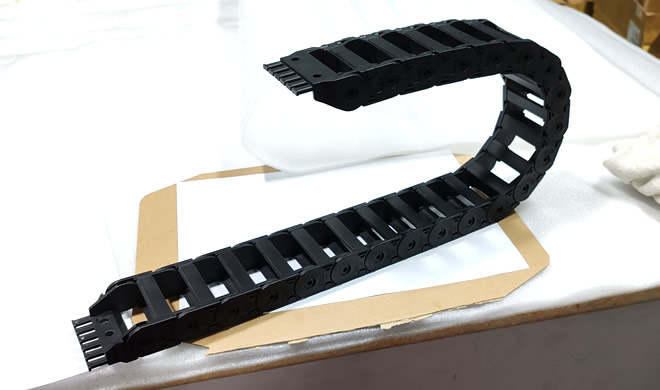
(Also called energy chain or drag chain)
Why Cable Carriers Break
In automated equipment, a cable carrier performs continuous reciprocating bending and long-term sustains bending, tension, impact, and friction. When actual conditions exceed the carrier's design envelope, the links, joints, or side plates gradually develop fatigue and wear, eventually fracturing. So a broken carrier should not be judged merely by "is the plastic good?"—the operating conditions must be checked against the carrier's specifications. For high-frequency, high-speed, and long-travel equipment, usage conditions weigh even more heavily on service life.
Too-Small Bend Radius Is a Common Cause
A cable carrier must run at or above its specified minimum bend radius. If the actual radius is smaller than the allowed value, the links bear excessive bending stress. After long repeated cycling, stress-concentration points—link roots, joints—easily develop fatigue cracks that grow until fracture. Therefore, installation should not only check whether the carrier fits the space, but also confirm the bend radius satisfies both the internal cables and the carrier itself.
High Speed and Acceleration Accelerate Fatigue
In high-speed reciprocation, links must reverse direction frequently. Larger acceleration raises the inertia of both the carrier and the internal cables. Sudden acceleration, deceleration, or direction reversals markedly increase the impact on links. Over time, a carrier adequate at normal speed may show wear, looseness, or even fracture. For high-speed automation, beyond the top speed, also consider acceleration, cycle frequency, and actual runs per day.
Poor Internal Cable Routing Causes Abnormal Load
A carrier usually holds cables, air hoses, and other flexible lines together. Overfilling, or cables pressing and twisting against each other, creates extra friction and drag in motion. If cables lack proper support, their weight and inertial force transfer to the carrier, adding load to the links. So when a carrier breaks, inspect not only the chain but also the count, diameter, weight, fixing method, and arrangement of the internal lines.
Improper Installation Causes Localized Stress
If the two ends are poorly fixed or the mounting is clearly skewed, the carrier can twist, take lateral load, and suffer local friction during travel. Especially when it does not follow the correct travel direction, some links may bear abnormal lateral load long term. The problem may be subtle at first but grows into cracks and wear with cycle count. After installation, ensure a smooth travel path free of jamming, interference, and abnormal swing.
Temperature and Environment Also Affect Life
Carrier materials have a defined operating temperature range. Prolonged high/low temperature or frequent thermal cycling can change material properties—high heat may soften or age some plastics; low temperature can reduce toughness. In cold conditions, high-speed, high-frequency bending makes links more impact-prone and crack-prone. Moreover, contaminants such as chips, dust, or chemical media can accelerate wear or degrade the material.
Fracture Location Helps Diagnose the Cause
| Fracture location | Likely cause | What to check / do |
|---|---|---|
| At link joints | Excessive bend stress, high cycle frequency, abnormal installation load | Re-measure actual bend radius vs. minimum; reduce speed/accel; check end-fix alignment |
| On side plates | Material aging, impact, long-term fatigue | Verify material vs. temperature/chemical exposure; reduce shock loading |
| Bottom / specific spot severe wear | Travel-path interference, rubbing on machine structure | Check travel path for contact; correct support/clamp; eliminate interference |
| New carrier breaks again quickly | Root cause not addressed (radius, speed, routing, mounting) | Re-examine all operating params and routing before replacing same model |
Purchasing Recommendations & Selection Checklist
When buying a cable carrier, work through the checklist below and select comprehensively:
Count and size of internal cables / hoses (diameter, outer jacket).
Total weight of all internal lines per unit length.
Minimum bend radius required by both cables and carrier (never below spec).
Travel / stroke and layout (horizontal, vertical, or rotary).
Speed and acceleration; confirm allowable values and cycle life.
Cycle frequency and actual runs per day.
Ambient temperature range and presence of chips, dust, or chemicals; confirm material suitability.
Inner height / inner width and load capacity—keep fill ratio within limit (commonly ≤60–70% of inner cross-section for cables, less for hoses).
Mounting method (fixed ends, strain relief for cables) to avoid twist and swing.
For high-speed, high-frequency equipment, prioritize the carrier's allowable speed, acceleration, and cycle life; with many internal lines, confirm inner space and load capacity are sufficient. For high/low temperature, dusty, or chemically aggressive environments, verify the material is suitable. Do not choose by outer dimensions and price alone.
Common Misconceptions
M1: A broken carrier must be a material-quality problem. Material matters, but bend radius, speed, acceleration, installation, and routing can also cause fracture.
M2: If it bends, there is no bend-radius limit. Carriers have a defined minimum bend radius; running below it long term clearly raises fatigue risk.
M3: More internal cables is better. Overfilling adds weight, friction, and inertia, and can hinder normal bending.
M4: A new carrier fixes the break. If the root cause is speed, misalignment, or wrong radius, a same-model replacement will likely break again.
FAQ
Q1: What are the most common operating causes of carrier fracture?
A: Too-small bend radius, high-speed/high-frequency running, excessive acceleration, poor internal routing, and installation misalignment.
Q2: What happens if the bend radius is too small?
A: It raises the repeated bending stress on links, leading to fatigue cracks and fracture over time.
Q3: Can overly heavy internal cables cause carrier fracture?
A: Yes. Excess cable weight increases the carrier's load and motion inertia, leaving links under extra long-term stress.
Q4: Why does a new carrier break again soon after replacement?
A: Re-check the bend radius, speed, acceleration, mounting method, and internal routing. If conditions are unchanged, a same-model swap won't fix the root cause.
Q5: What parameters to confirm when buying a cable carrier?
A: Focus on inner height, inner width, minimum bend radius, total cable weight, travel, speed, acceleration, and working environment.
Copyright © 2016-2025 Forrun (Guangdong) Industrial Technology Co., Ltd All Rights Reserved.