- Contact Us
- -
- Payment
- -
- 中文版
Knowledge Center · 2026-09-20 09:36:24 · 6 hits
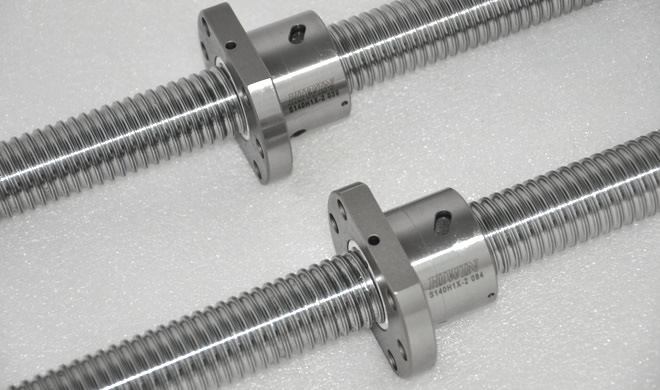
Why Vertical Lifting Demands More
In horizontal motion, a ball screw mainly delivers horizontal drive force and carries the moving load. In a vertical lift, it must continuously overcome gravity—the weight of the platform, fixtures, and workpiece creates a persistent axial load, with extra dynamic load during start, stop, and acceleration. Therefore, for vertical use you cannot size the screw by rated load alone; you must analyze maximum load, speed, acceleration, and duty cycle. A crucial point: a ball screw is not, by itself, a safety brake. Whether the load drops when power fails depends on the lead, efficiency, drive method, and the mechanism's overall braking design.
First, Solve the Load-Drop Problem
The top risk in a vertical lift is the load falling after power loss. Ball screws have high transmission efficiency—often 90% or more—so, unlike a worm drive, they generally do not self-lock and can be back-driven by the load under certain lead/load conditions. Never assume "the ball screw is self-locking" and skip braking. For equipment with personnel nearby, valuable workpieces, or large lift masses, fit an independent safety hold: motor brake, mechanical lock, anti-fall device, or other dedicated measure. Safety must follow the actual risk assessment—the ball screw must not be the sole means of support or fall protection.
Power-Loss Holding Solutions: Comparison
| Solution | Principle | Applicable scenario | Notes |
|---|---|---|---|
| Motor holding brake (electromagnetic) | Spring-applied, electrically released brake on the motor | Most servo/stepper lifts; holds on power loss | Holds the drivetrain only—verify holding torque vs. load |
| Mechanical lock (pin / ratchet / solenoid) | Physical lock fixes the position | Intermittent positioning, maintenance lockout | Positive mechanical stop; not for continuous motion |
| Anti-fall / safety nut | Redundant nut or clamp arrests descent | Personnel / valuable load, large mass | Independent of drive; last-line protection |
| Worm-gear self-locking (if present) | Worm cannot be back-driven above its lead angle | Drives that include a worm stage | A ball screw itself does not self-lock |
Focus on Axial Load When Sizing
The vertical load includes not only the workpiece but also the lift platform, fixtures, sliders, and all moving mass, plus inertial load from acceleration/deceleration. Sizing by static weight alone can let the real load exceed expectations during high-speed or frequent start-stop duty.
Worked example (illustrative): a lift of total mass m = 200 kg (platform + workpiece) accelerating upward at a = 1 m/s² with screw efficiency η ≈ 0.9 and lead L = 10 mm:
Peak axial force to accelerate upward: F = m·(g + a) = 200 × 10.81 ≈ 2162 N
Required motor thrust ( accounting for efficiency): F/η ≈ 2402 N
Required motor torque: T = F·L / (2π·η) = 2162 × 0.01 / (2π × 0.9) ≈ 3.8 N·m
Note that static weight alone (m·g ≈ 1962 N) understates the peak, and efficiency raises the demand further—exactly why static-weight sizing is unsafe. Calculate the maximum axial load from the actual duty cycle, apply a safety factor, and then select the screw size while verifying the dynamic load rating, static load rating, and expected life.
Rebalance Lead and Speed
A larger lead gives higher linear speed at a given motor rpm, but also affects thrust, drive characteristics, and back-driving behavior under vertical load. Too large a lead can raise the required drive torque and reduce holding ability; too small a lead can leave lift speed insufficient or force very high screw rpm to meet cycle time. So vertical lifting should not just chase "large lead = high speed"—set the lead from lift speed, motor rpm, load, and braking needs together.
Check Column (Buckling) Stability
When a ball screw is mounted vertically and acts in compression, consider buckling. The longer the screw, the smaller the diameter, and the weaker the support, the more critical speed and buckling resistance become limiting factors. For long-stroke, heavy-load lifts, do not judge by dynamic load rating alone. Verify stability from shaft diameter, effective length, support configuration, and mounting structure; if needed, increase diameter, improve support, or shorten effective length.
Accuracy Is Also Shaped by Gravity and Stiffness
A vertical lift is under constant gravity; if the mounting plate, platform, or connections lack stiffness, the mechanism can tilt, deform, or see local eccentric load. A high-precision screw does not guarantee equal precision of the whole lift. Poor guide stiffness or misalignment between screw and rail can impose extra radial and bending load on the screw. The ball screw should mainly transmit axial drive force—side loads and guidance belong to independent linear guides.
Lubrication and Vertical Mounting Also Matter
In long vertical runs, lubricant distribution differs from horizontal mounting under gravity, temperature, and operating state. For frequent operation, set a sensible re-greasing/lubrication interval from speed, load, ambient temperature, and lubricant type. Also watch the concentricity of screw, nut, and support bearing. Obvious vertical misalignment raises running resistance, causes local wear, and can generate abnormal noise.
Purchasing Recommendations
When buying a ball screw for vertical lifting, first confirm maximum lift mass, lift speed, acceleration, stroke, duty frequency, and mounting method; then set screw diameter, lead, accuracy grade, and support structure. Explicitly define the load-hold scheme under power loss. For risky lifts, prioritize independent safety—brake, mechanical lock, or anti-fall—rather than treating screw friction as reliable braking. For long-stroke vertical units, also verify critical speed, buckling stability, and mounting stiffness. Do not spec on "rated load" alone.
Common Misconceptions
M1: The ball screw automatically prevents the platform from falling. Not guaranteed. With high efficiency, back-driving depends on lead, load, and system design; provide separate safety holding.
M2: Rated load greater than platform weight is enough. You must also account for acceleration, shock load, life, stability, and the real duty cycle.
M3: The ball screw can take all side loads. It is for axial transmission; side loads should be carried by linear guides or other independent guidance.
M4: Vertical and horizontal selection are identical. Vertical duty adds persistent gravity load and power-loss drop risk, so holding, braking, and protection must be designed in.
FAQ
Q1: What is the biggest caveat for ball screws in vertical lifting?
A: First resolve gravity load and power-loss drop; then size for load, speed, life, and accuracy.
Q2: Can a ball screw directly stop the platform from falling?
A: Do not treat it as a general fall-arrest measure. Back-driving depends on the specific screw and load; add an independent brake or anti-fall device when needed.
Q3: Why verify screw stability in vertical lifts?
A: Long-stroke, heavy-load screws can be in compression and must avoid column buckling.
Q4: Must the ball screw carry the platform's side force?
A: Avoid it. Side force and guidance should come from linear guides or similar.
Q5: What parameters to confirm when buying a vertical-lift ball screw?
A: At minimum: lift mass, stroke, speed, acceleration, screw diameter, lead, accuracy grade, support method, and the braking/anti-fall scheme.
Copyright © 2016-2025 Forrun (Guangdong) Industrial Technology Co., Ltd All Rights Reserved.