- Contact Us
- -
- Payment
- -
- 中文版
Knowledge Center · 2026-09-18 09:42:04 · 6 hits
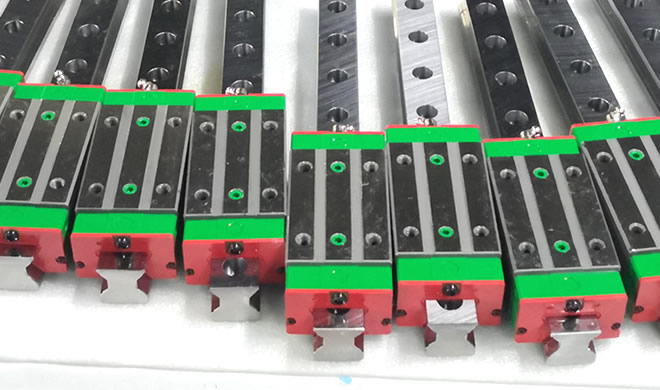
What an Accuracy Grade Mainly Addresses
A linear guide's accuracy grade reflects how well it controls positioning accuracy, straightness, and running smoothness during motion. Different grades typically differ in running trajectory, mounting datum, and the height/width deviation between rails. For ordinary conveyance, handling, and low-precision linear mechanisms, an overly high grade rarely translates into real equipment performance; but for precision positioning, inspection, or machining equipment, insufficient guide accuracy can cap the final positioning performance—even if the motor, ball screw, and control system are highly accurate. In practice, the accuracy grade should be determined backward from the motion accuracy the whole machine must ultimately achieve.
Equipment Positioning Accuracy Sets the Basic Range
If the machine only needs the workpiece to move stably, with loose final-position tolerance, there is usually no need for the highest grade. If higher positioning and repeatability are required—precision handling, vision inspection, dispensing, measurement—then the guide's motion accuracy must be raised. But note: guide accuracy ≠ machine positioning accuracy. The motor encoder, ball screw, coupling, mounting datum, frame stiffness, and control errors all affect the final result. So you should not assume that a ±0.01 mm positioning requirement means the rail itself must be 0.01 mm accurate; instead, analyze the error sources across the entire transmission chain.
Running Smoothness Is Also a Key Factor
For high-speed reciprocating mechanisms, straightness error, mounting error, or height difference between rails can make the slider's running resistance vary. At low speed this may be negligible; but as speed and acceleration rise, it shows up as vibration, noise, rough motion, or even increased positioning error. Thus, for high-speed automation, beyond rated load and life, you must check whether the accuracy grade matches the mounting accuracy.
Don't Ignore the Guide-to-Structure Accuracy Relationship
A highly accurate rail does not guarantee accurate motion after installation. If the mounting surface flatness is poor, the rail datums are inconsistent, or there is obvious twist and preload error during fitting, even a high-grade rail cannot deliver its performance. Especially with dual-rail or multi-slider layouts, parallelism error between the two rails raises slider resistance and can cause local seizing. The rail grade and the mounting datum accuracy must match—if the structure itself cannot meet the required mounting accuracy, buying a higher grade is usually pointless.
High-Precision Rails Can't Shine When Stiffness Is Insufficient
Guide accuracy is only one part of the motion system. If the base, mounting plate, or frame lacks stiffness and deflects under load, the rail's inherent accuracy is cancelled by structural deformation. For example, a precision stage using high-grade rails but mounted on an aluminum plate that bends noticeably under load variation will still fail to meet the required platform position accuracy. So judge the grade together with the rail, mounting surface, frame, load, and drivetrain—not the rail alone.
Leave a Reasonable Margin Based on Actual Needs
Generally, do not spec the rail right at the limit of the allowable error. Over time, temperature change, mounting error, load variation, and wear all erode performance, so keep a sensible margin. But bigger is not always better: a general handling unit that only needs ordinary positioning yet buys the top grade pays more and also demands a better installation environment and assembly process. The sound approach is to set the machine's total allowable error first, then analyze the rail's share of that error budget, and thus pick the right grade.
Accuracy Grade Naming & Typical Error (Reference)
| Grade (common label*) | Representative straightness / running accuracy | Typical use |
|---|---|---|
| Normal (C) | ~0.02–0.05 mm per 1000 mm run | General automation, handling, conveyance |
| High (H) | ~0.01–0.02 mm | General precision mechanisms |
| Precision (P) | ~0.005–0.01 mm | Inspection, dispensing, precision stages |
| Super-precision (SP) | ~0.003–0.005 mm | CNC, measurement, optics |
| Ultra-precision (UP) | ≤0.003 mm | Semiconductor, ultra-fine positioning |
*Manufacturers commonly label grades as Normal (C) / High (H) / Precision (P) / Super-precision (SP) / Ultra-precision (UP); exact codes vary by brand. The figures above are representative orders of magnitude—actual values depend on rail size and model. Always consult the manufacturer's catalog for the specific grade's guaranteed tolerances.
Purchasing Recommendations & Selection Checklist
Before purchasing, work through the following checklist and then set the rail grade:
Define the required positioning accuracy and repeatability of the equipment.
Determine running speed, acceleration, and load variation.
Assess the mounting-surface flatness and frame stiffness the structure can achieve.
Allocate the rail's share within the total error budget; pick the grade accordingly.
For ordinary conveyance/handling, prioritize cost-performance over top grade.
For vision inspection, precision positioning, or machining, verify the rail's accuracy grade and geometric tolerances.
For dual-rail layouts, match both rails' grades, mounting datum, and paired-use requirements.
Confirm the appropriate preload class (light / medium / heavy) for the duty.
Verify the assembly process can realize the grade—high grades need a good mounting surface.
Common Misconceptions
M1: Higher grade is always better. High-grade rails need higher mounting and structural conditions; without them, raising the grade barely improves the machine.
M2: Rail grade equals machine positioning accuracy. Final accuracy is also shaped by screw, motor, encoder, mounting error, frame deflection, and control system.
M3: Ordinary equipment need not consider rail grade at all. Even with loose positioning needs, grade still affects smoothness, noise, and long-term condition.
M4: Look at grade, ignore mounting accuracy. Surface flatness, parallelism, and mounting method directly decide how a high-grade rail actually performs.
FAQ
Q1: Is a higher linear-guide accuracy grade always better?
A: No. Choose by the equipment's positioning need, running condition, and mounting capability; too high a grade adds cost and assembly demands.
Q2: Does rail grade directly determine machine positioning accuracy?
A: No. The rail is only one link; transmission, control, mounting, and structural deformation also contribute error.
Q3: Must high-speed equipment use high-precision rails?
A: Not necessarily, but high speed usually raises the bar on straightness, mounting accuracy, and running smoothness—judge by the actual duty.
Q4: Can a high-grade rail compensate for poor mounting-surface accuracy?
A: Usually not. Datum error can directly degrade the rail's running accuracy and even cause abnormal slider resistance.
Q5: What should I confirm first when buying linear guides?
A: First set the accuracy requirement, load, speed, stroke, and mounting structure; then determine specification, accuracy grade, and preload class together.
Copyright © 2016-2025 Forrun (Guangdong) Industrial Technology Co., Ltd All Rights Reserved.