- Contact Us
- -
- Payment
- -
- 中文版
Knowledge Center · 2026-11-18 09:33:16 · 17 hits
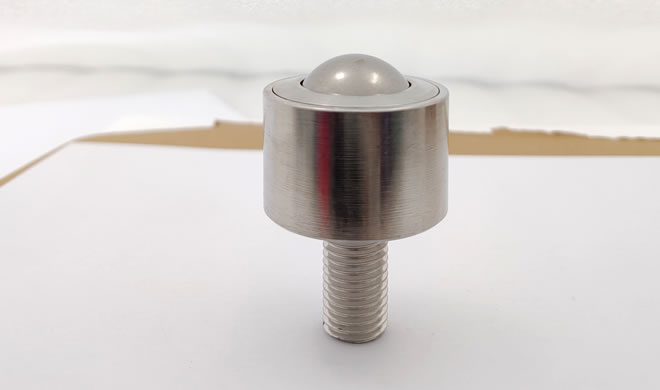
Ball transfer units are commonly fitted to worktables, conveyor tables, and material-handling equipment to let workpieces move freely in any direction by rolling. In practice, simply mounting the units does not guarantee smooth movement—the height of the ball surface relative to the mounting plane is equally important.
If the mounting height is too low, the workpiece bottom may interfere with the surrounding table or support structure, so the real weight is carried not by the balls but by other contact surfaces. Movement resistance then increases markedly, and localized dragging can occur. If the height is too high, the workpiece contacts the ball fully but the support points become relatively proud, shifting the center of gravity and the support condition. For large, uneven-bottomed, or tall workpieces, wobble is likely, and noticeable tilt may appear when the direction of motion changes.
In essence, mounting height adjusts the relative position between the workpiece bottom and the support plane, ultimately determining which support points carry the load and how the workpiece is loaded during movement.
1. Problems Caused by Insufficient Mounting Height
When ball transfer units are mounted too low, the most common problem is that the ball surface fails to form an effective primary support. For example, if the workpiece bottom is not perfectly flat and the surrounding mounting plate sits at nearly the same height as the ball, the workpiece may contact both the plate and the balls during movement. Because the two contacts produce different resistance, the push feels uneven—light in places, heavy in others—and sticking can occur at certain positions. This height difference is especially pronounced on manually pushed transfer tables.
Under proper conditions, the balls should carry most of the weight, with the bottom kept at a reasonable clearance from fixed structures. Without sufficient height, a stable rolling support cannot be established.
2. Effects of Excessive Mounting Height
Ball transfer units are not "the higher, the better." When mounted too high, the workpiece is lifted as a whole and the relative positions of the support points change. For large plates, boxes, or equipment parts with some bottom deformation, some balls may take heavy concentrated loads while others lose contact. Moreover, raising the workpiece reduces its stability. Especially when multiple balls form the support plane, any height variation among them can cause slight sway. As the workpiece is pushed, the load redistributes among support points and the pushing feel becomes unstable. Therefore, what matters in installation is not the height of a single unit but the height uniformity across the entire ball support plane.
3. How to Determine Mounting Height
First examine the workpiece bottom structure. If the bottom is relatively flat, the balls should form a consistent support plane while avoiding interference with the mounting plate, table, or other non-rolling surfaces. If the bottom has protrusions, grooves, or reinforcement ribs, height cannot be set from overall thickness alone—it must be designed around the actual contact regions. Otherwise, even with identical nominal ball heights, some balls may be loaded while others hang free after installation.
For heavy workpieces, also calculate the support condition from the rated load capacity of each unit and their number. Do not simply assume that "workpiece weight ÷ number of balls" equals the actual load per ball—the center of gravity, bottom flatness, and height errors of each support point all cause uneven load distribution.
4. Height Consistency When Installing Multiple Units
When multiple ball transfer units are arranged in an array, height consistency matters more than the individual unit's mounting dimension. If some units sit clearly higher, the workpiece loads those points first, increasing local load; if lower, they may fail to support effectively. As the workpiece moves, the loaded points keep shifting, easily causing fluctuating resistance.
During installation, check the mounting-hole depth, base-plate flatness, and the unit's own mounting dimension, and keep the ball surfaces as close as possible to the same working plane. For high-precision transfer platforms, place a standard workpiece after installation and test it—check for obvious sticking, wobble, or local settling when pushed in different directions.
5. Purchasing Advice
When procuring ball transfer units, do not confirm only ball diameter and load capacity. Also confirm mounting height, mounting method, ball-height tolerance, and base dimensions. For ordinary workpiece transfer, focus on how the mounting height matches the equipment table. For heavy workpieces, verify against weight, number of support points, and actual load distribution. For equipment using multiple units, choose products with good dimensional consistency and define the mounting-plate thickness and hole structure in advance to avoid on-site shim adjustments.
6. Common Misconceptions
Misconception 1: The higher the ball, the easier the movement. Not true. Excessive height can reduce stability and concentrate load on local supports.
Misconception 2: Same model means identical height. Actual height also depends on mounting-hole depth, plate flatness, and assembly error.
Misconception 3: Counting units determines capacity. Actual load is not always evenly distributed; consider center of gravity, bottom condition, and support-point loading.
Misconception 4: Poor movement means a defective unit. Unreasonable mounting height, an uneven table, or an unsuitable workpiece bottom can equally increase resistance.
FAQ
What happens if the mounting height is too low?
The workpiece bottom may interfere with the table, preventing the balls from forming an effective rolling support and increasing movement resistance.
What are the effects of excessive mounting height?
The workpiece center of gravity rises, support stability drops, and some balls take excessive local load.
Should multiple ball transfer units share the same height?
Yes—keep the working ball surfaces on the same support plane; otherwise load distribution becomes uneven and resistance varies.
How do I choose the mounting height?
Determine it together with the workpiece bottom structure, mounting-plate dimensions, and the height of surrounding support surfaces—not from the unit's own size alone.
Does height error affect use?
Yes. Large height differences can leave some balls loaded and others hanging free, harming movement stability and unit life.
Copyright © 2016-2025 Forrun (Guangdong) Industrial Technology Co., Ltd All Rights Reserved.