- Contact Us
- -
- Payment
- -
- 中文版
Knowledge Center · 2026-11-20 09:28:19 · 3 hits
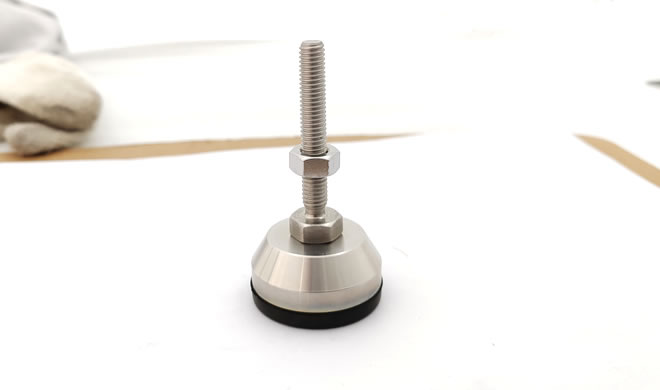
Leveling feet are fitted at the base of a machine to carry its weight, set it level, and decouple it from the floor. In equipment with motors, shock loads, or cyclic motion, the vibration behaviour of these feet directly affects running stability and structural life. This article explains how leveling feet reduce vibration, which factors govern their performance, and how to select them for different operating conditions. Two distinct mechanisms are involved: damping, which dissipates vibrational energy within the elastic element, and isolation, which blocks the transmission of force to the floor. A well-chosen leveling foot normally provides both.
1. The Role of Leveling Feet in Equipment Support
A leveling foot combines an adjustable threaded stud with a support pad. Its three basic jobs are to distribute the machine's static weight over a defined contact area, to compensate for uneven floors through fine height adjustment, and to provide an elastic interface between the machine base and the ground. Done properly, this also protects the floor, prevents the machine from wandering, and keeps the frame from being distorted by an uneven foundation—an important prerequisite for any precision or high-speed equipment.
2. How Leveling Feet Reduce Vibration
2.1 Energy Absorption by Elastomeric Materials
The pad is commonly made from rubber (NR, NBR) or polyurethane (PU). Under dynamic load the elastomer deforms and recovers cyclically; because of its hysteresis, part of the vibrational energy is converted into heat instead of being passed through to the floor. This lowers the transmitted force and reduces structure-borne noise, while also cushioning the contact surface against impact.
2.2 Damping and Resonance Control
Damping limits vibration amplitude, particularly when the excitation frequency approaches the mounted natural frequency of the machine–foot system. For a single-degree-of-freedom system, isolation only begins when the frequency ratio exceeds √2 (f / fₙ > √2). Below this threshold the transmitted vibration is amplified rather than reduced, and near f / fₙ ≈ 1 resonance occurs.
This creates a genuine design trade-off: higher damping is valuable around resonance because it suppresses the amplification peak, but it slightly reduces isolation efficiency at high frequency ratios. Under shock loads, damping also shortens the post-impact ringing, helping the machine settle quickly. Selecting a foot is therefore not simply a matter of choosing the softest pad available.
3. Key Factors Affecting Damping Performance
3.1 Material Hardness and Elasticity
Hardness, usually specified on the Shore A scale, determines stiffness. A harder pad carries more load and keeps the machine stable, but its higher stiffness raises the mounted natural frequency and leaves less static deflection—so low-frequency vibration is less effectively isolated. A softer pad deflects more and isolates better, but can allow the machine to wobble, introduce creep, and reduce positioning stability. The correct grade is the one that matches both the equipment weight and the dominant excitation frequency.
3.2 Load Matching
Nominal load per foot is the total weight divided by the number of feet, but the actual figure is rarely uniform: center-of-gravity offset, frame rigidity, and leveling adjustments all redistribute it. Each foot should retain a clear margin below its rated capacity. Running continuously at or near the limit causes compression set and permanent loss of elastic recovery, so the isolation margin gradually disappears. For equipment with shock or reciprocating motion, check the dynamic load rating as well as the static one.
3.3 Installation and Contact Condition
Incomplete floor contact, tilted studs, or uneven height among feet lead to localized overload, with some feet carrying little or no load. After leveling, the lock nut should be tightened to prevent the setting from drifting under vibration. Where horizontal forces are significant, anchoring or an anti-slip pad should be considered. Installation quality is as decisive as the pad material itself.
4. Selection Guidelines by Vibration Condition
| Operating condition | Recommended foot | Key checks |
|---|---|---|
| Light vibration (control cabinets, light conveyors, inspection stands) | Standard rubber-padded leveling foot | Static load, floor flatness, anti-slip |
| Moderate vibration (motor drives, presses, packaging machines) | High-damping rubber or polyurethane pad | Shore A grade, damping loss factor, load margin |
| Continuous vibration or shock loads | Dedicated anti-vibration leveling foot or composite (metal–elastomer sandwich) mount | Dynamic load rating, fatigue life, deflection limit |
| High-precision equipment (metrology, optical, dispensing) | Low-creep precision leveling foot, optionally combined with a damping pad | Compression set, thermal drift, deflection under load |
For high-precision machines the compression of the pad must be controlled, since even small vertical displacement or long-term creep shifts the working datum. Where the required softness conflicts with positional accuracy, a separate isolation mount with controlled stiffness is usually the better solution.
5. Evaluating Overall Performance
The effect of a leveling foot is best judged by a few measurable indicators rather than by feel alone:
| Indicator | What it reveals |
|---|---|
| Transmissibility / isolation efficiency | Fraction of excitation force reaching the floor |
| Mounted natural frequency (fₙ) | Frequency above which isolation begins |
| Static deflection and compression set | Available elastic reserve and long-term stability |
| Structure-borne noise level | Practical result at the floor and adjacent structure |
| Load distribution across feet | Whether installation and leveling are correct |
A quick engineering check. For linear elastic behaviour, the mounted natural frequency relates to static deflection as fₙ ≈ (1/2π)·√(g/δ). To isolate a 25 Hz excitation, fₙ must stay below roughly 25/√2 ≈ 17.7 Hz, which corresponds to a static deflection of about 0.8 mm under the supported mass. This is why simply specifying a hard foot "for stability" can remove the isolation effect altogether: without sufficient deflection, the mounted natural frequency rises into the machine's operating range and vibration is amplified instead of attenuated.
In summary, leveling feet can substantially reduce vibration transmission and structure-borne noise, but their effectiveness depends strongly on material, load, and installation. Correct selection combined with disciplined leveling and locking improves running stability at controlled cost. For very low excitation frequencies, heavy shock loads, or demanding precision requirements, dedicated anti-vibration mounts should be evaluated alongside—or instead of—standard leveling feet.
Copyright © 2016-2025 Forrun (Guangdong) Industrial Technology Co., Ltd All Rights Reserved.