- Contact Us
- -
- Payment
- -
- 中文版
Knowledge Center · 2026-11-19 09:23:47 · 2 hits
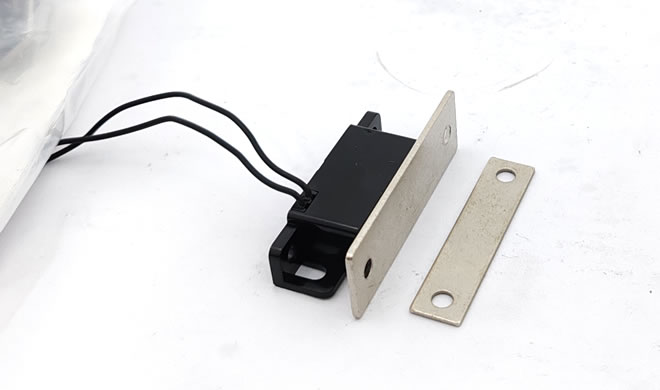
A switch-type magnetic door catch combines magnetic holding with an electrical status signal in a single compact fitting. It keeps a door or panel securely closed while simultaneously telling the control system whether that closure has actually occurred—a small function that matters wherever equipment safety, environmental integrity, or access control depends on a verified closed state. The following sections outline its construction, typical applications, and the points to check during selection.
1. Structure and Operating Principle
A switch-type magnetic door catch consists of two functional parts: a magnetic holding unit and an electrical switching element. The holding unit—typically a permanent magnet paired with a ferrous keeper plate—provides the force that holds the door closed without a mechanical latch. The switching element, most commonly a reed contact or a Hall-effect sensor, detects the presence of the actuator and changes state when the door reaches its closed position.
The result is a discrete on/off signal that downstream equipment—a PLC input, a machine controller, or an alarm panel—can read as a "door closed" status. Because holding and sensing share one assembly, no separate limit switch or proximity sensor is needed at the door edge. Some series also provide an LED indicator or a delayed output for status confirmation.
The signal confirms position only; it does not measure holding force or verify seal integrity. Where the closed state must be fail-safe, the output type and contact behaviour should therefore be chosen to match the required logic.
2. Typical Applications
2.1 Industrial Automation Equipment Doors
On industrial machinery and automated equipment, whether a door is fully closed is directly linked to safe operation. A switch-type magnetic door catch both holds the door in place to prevent unintended opening and outputs a "door closed" signal that permits the control system to start, enable, or unlock the machine. It is particularly suited to electrical control cabinet doors, inspection and access hatches, and movable machine guards.
Where a door forms part of a personnel-safety interlock, a standard signal-type magnetic catch should be treated as a status device only; a safety-rated interlock switch compliant with the applicable machinery safety standards should be specified instead.
2.2 Cleanroom and Laboratory Doors
In cleanrooms, doors must close tightly to maintain a positive- or negative-pressure differential. A switch-type magnetic door catch holds the leaf firmly against its seal and reports the closed state in real time, allowing air-handling units, air showers, and pressurisation fans to be started or sequenced with a defined delay. This closes the loop between physical closure and environmental control and raises the overall level of cleanroom automation.
2.3 Intelligent Access Control and Building Systems
In building automation, these catches are commonly integrated into electrically controlled or security doors to confirm that the leaf is closed. The output is wired to a security panel, an access controller, or an annunciator to support functions such as unauthorized-opening alarms, door-ajar indication, and delayed-unlock interlocks. A single device thereby covers both mechanical closure and the status feedback the building management system needs.
2.4 Medical Equipment and Premium Residential
Medical carts, electric hospital beds, and similar mobile equipment use switch-type magnetic catches to keep trays, covers, and side panels secured during movement and to confirm they are in place before operation. In high-end residential automation, automatic swing doors use the same principle to trigger lighting or appliance start-up when a door opens or closes, integrating door position into the home control scene.
3. Key Advantages
Dual function in one device. Magnetic holding and door-status detection are combined, reducing component count and saving panel space.
Simple installation. Only the magnet/actuator and the sensor body need to be fixed to the door and frame, with a single signal cable run to the controller—no complex wiring or mechanical linkage.
Reliable, flexible signalling. Depending on the model, outputs are available as volt-free dry contacts (normally open / normally closed) or as solid-state PNP/NPN signals, making the catch easy to interface with PLCs and control panels.
4. Selection and Installation Considerations
Output type: Match the signal to the controller input—dry contacts for universal use, PNP/NPN where a 24 V DC sensor input is available. Confirm whether normally-open or normally-closed behaviour suits the intended logic.
Holding force and air gap: Select a magnet strength adequate for the door mass and seal resistance, and respect the specified sensing distance. Excessive mounting gap is a common cause of intermittent signals.
Environment: For cleanrooms, washdown areas, or outdoor cabinets, check the IP rating, housing material, and resistance to cleaning agents.
Alignment and mounting: Verify actuator-to-sensor alignment over the door's full travel and allow for hinge play or panel deflection.
Electrical rating: Check switching voltage, current, and cable length, and provide appropriate protection for inductive loads.
Copyright © 2016-2025 Forrun (Guangdong) Industrial Technology Co., Ltd All Rights Reserved.