- Contact Us
- -
- Payment
- -
- 中文版
Knowledge Center · 2026-09-23 10:02:29 · 21 hits
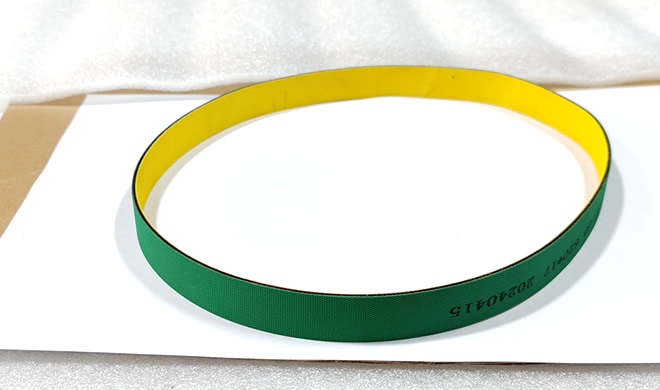
1. Why Conveyors Adopt Flat Belts
A conveyor's main task is to move workpieces, packages, or other material continuously from one position to another. Unlike a chain or timing-belt drive, a flat belt transmits motion through friction between the belt and the pulleys, while the belt surface contacts the material and carries it along. Because this structure needs no tooth engagement with a sprocket or pulley, it is especially well suited to equipment where smooth conveying, low noise, and low structural cost matter.
2. Flat Belts Run Smoothly
A flat belt has no toothed mesh; it relies on friction drive, so under proper tension and load it runs relatively smoothly. For equipment that continuously conveys small parts, packages, or sheet material, smooth running helps reduce wobble and impact during transport. Where the line also performs vision inspection, barcode scanning, or positioning, the steadier motion makes it easier to synchronize takt with upstream and downstream equipment.
3. Simple Structure Eases Maintenance
A flat belt conveyor typically consists of the belt, a drive pulley, an idler (driven) pulley, and a tensioning mechanism — a relatively simple drivetrain. When the belt wears, ages, or is damaged, it can usually be replaced directly, without handling links one by one as with a chain drive. And because there is no tooth form, there is no concern about tooth-to-groove meshing; maintenance mainly tracks belt tension, tracking (misalignment), and surface condition.
4. Noise Is Usually Low
A flat belt's contact is continuous, without the periodic impact of timing-belt tooth engagement or chain links, so under suitable conditions its noise is typically low. This is practical for automation lines with frequent operator presence, compact layouts, or noise-sensitive environments. Note, however, that conveyor noise is not decided by the belt alone — the motor, gearbox, bearings, rollers, and even frame resonance can all be noise sources.
5. Good Flexibility for Continuous Conveying
A flat belt is flexible enough to loop continuously around pulleys. For a long conveyor, the belt and rollers can be configured to the equipment length, and the belt's compliance helps absorb shock in frequently running systems. But if the equipment must hold strict angular synchronization between the drive and driven pulleys, a flat belt is not the best choice — friction drive entails elastic stretch and slip.
6. Conveying Surface Can Be Matched to the Material
Because the belt touches the material directly, its surface material and structure affect conveying performance. For smooth-surfaced products, consider the belt's friction characteristic; for anti-slip needs, choose a surface structure based on load weight, incline angle, and speed. For food, electronics, or packaging, also factor in cleanability, oil resistance, wear resistance, and the working environment when selecting the belt material.
7. Which Conveying Scenarios Suit Flat Belts
Flat belts fit continuous, horizontal, and lower-precision conveying — production-line transport, packaging conveyors, part transfer, and automated loading/unloading. If the equipment demands strict synchronized positioning or must transmit large torque, re-evaluate whether a flat belt is appropriate; a timing belt or chain may be better. The flat belt's strength is not "fits every conveyor," but the balance it strikes among simple structure, smooth running, low noise, and easy maintenance.
8. Drive Selection: Flat Belt vs. Timing Belt vs. Chain
| Criterion | Flat Belt | Timing Belt (Synchronous) | Chain |
|---|---|---|---|
| Drive principle | Friction | Tooth engagement | Roller / link engagement |
| Synchronization | None (slip possible) | Positive, accurate | Positive, accurate |
| Noise level | Low | Medium | Higher (link impact) |
| Speed range | Medium | High | Medium–High |
| Torque capacity | Lower (friction-limited) | High | High |
| Maintenance | Simple; belt replacement | Moderate; alignment critical | Lubrication; link replace |
| Relative cost | Low | Medium | Medium |
| Best suited to | Continuous, smooth, low-noise conveying | Precise positioning, synchronized index | Heavy load, harsh env., long spans |
Takeaway: choose a flat belt when smooth, quiet, low-cost conveying is the priority and exact sync is not required; choose a timing belt or chain when positioning accuracy or high torque matters.
9. Purchasing Recommendations
When sourcing a flat belt, do not confirm only length and width — also pin down conveying speed, load, roller diameter, tensioning method, incline angle, and working environment. For heavy loads, focus on the belt's tensile strength and wear resistance; for high speed, consider running stability and splice (joint) quality; for oil, heat, or humidity, confirm the material can endure it long term. For an in-service conveyor, replace against the original belt model, size, and actual duty — do not select by appearance dimensions alone.
10. Common Misconceptions
“No teeth, so it can't slip.” Wrong. A flat belt relies on friction; overload, insufficient tension, or a contaminated surface can all cause slipping.
“Tighter is better.” No. Excessive tension raises the load on the belt, pulley bearings, and drivetrain, and can shorten service life.
“Flat belts suit every conveyor.” Not always. Equipment needing high-precision sync drive, large torque transfer, or strict positioning may suit another drive type better.
“Wider belt always means higher capacity.” Width helps, but actual capacity also depends on belt material, thickness, construction, tension state, and duty conditions.
11. Slip — Causes, Checks & Fixes
| Symptom | Likely cause | What to check / do |
|---|---|---|
| Slips under load | Insufficient belt tension | Raise tension to spec; verify tensioner travel |
| Slips at start/stop or reversal | Overload, small wrap angle | Reduce load or increase pulley wrap angle; review drive ratio |
| Intermittent slip | Contaminated belt/pulley (oil, dust, moisture) | Clean surfaces; switch to oil-resistant belt if needed |
| Belt wanders / mistracks | Pulley misalignment, off-center load, no crown | Align pulleys; center the load; confirm crowned pulley |
| Premature wear or cracking | Over-tension, wrong material, heat | Lower tension; select material for the temperature/duty |
| Edge wear / side contact | Misalignment, tracking drift | Re-align; adjust tracking; check rollers parallel |
Note: a flat belt's allowable tension is bounded — too little slips, too much damages bearings and the belt. The correct value comes from the belt spec and the required friction grip for the load, not from "as tight as possible."
12. FAQ
Q: Why do conveyors commonly use flat belts?
A: Because they are simple, run smoothly, are low-noise, and are easy to maintain and replace.
Q: Can a flat belt conveyor slip?
A: Yes. As a friction drive, it can slip under insufficient tension or excessive load.
Q: Are flat belts suitable for high-speed conveying?
A: They can be used within a certain speed range, but the allowable speed must be confirmed against belt material, roller diameter, splice quality, and actual duty.
Q: What is the difference between a flat belt and a timing belt?
A: A flat belt mainly uses friction drive and is simple in structure; a timing belt transmits through tooth engagement, generally giving better synchronization and positioning.
Q: What parameters should I confirm when buying a flat belt?
A: Typically belt length, width, thickness, material, and splice method, plus the conveyor's load, speed, and working environment.
Copyright © 2016-2025 Forrun (Guangdong) Industrial Technology Co., Ltd All Rights Reserved.