- Contact Us
- -
- USD
Knowledge Center · 2026-09-03 09:23:15 · 7 hits
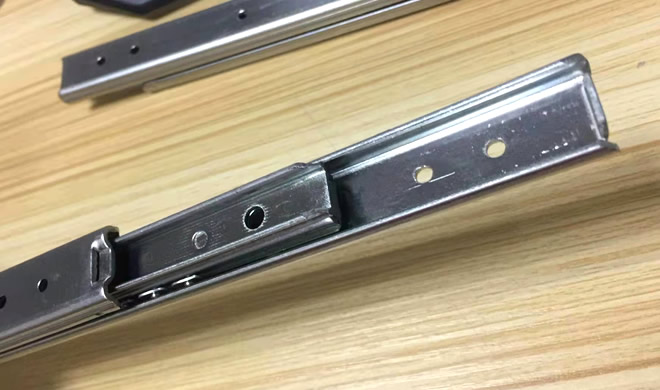
The design‑and‑selection workflow for industrial slides shall start from the real‑world mechanical application. First, define the slide’s core function: pull‑out operation, linear reciprocating travel, or positioning guidance. Then confirm payload magnitude, motion orientation and effective stroke. For horizontally mounted slides, special attention shall be paid to the weight of moving assemblies plus external applied loads. For vertically fitted configurations or cantilever structures, gravitational force and overturning moment exert critical impacts on slide performance. Load evaluation should not merely adopt the average static weight of equipment. In applications with offset load, shock impact or frequent start‑stop cycles, verification shall be performed against maximum practical operating conditions.
The rated stroke of a slide must cover the required effective travel of the mechanism. During engineering design, available space under both fully extended and fully retracted positions shall be verified. When slides are embedded inside machine frames, factors including slide thickness, mounting‑hole layout and clearance toward adjacent components must be accounted for. For drawer‑type assemblies and maintenance access doors, mechanical interference between fully extended slides and machine frames should be strictly avoided. Accordingly, effective stroke cannot be simply equated to raw slide length; comprehensive assessment combining mounting orientation and motion path is mandatory.
Given identical total weight, uniformly distributed loading produces completely different mechanical effects compared with concentrated front‑end loading. When the center‑of‑gravity sits far away from the mounting reference plane, substantial overturning moment arises, generating localized stress spikes on slides. This leads to elevated moving resistance, variable clearance and even permanent slide deformation. For heavy‑duty slides, beyond checking nominal load ratings, engineers must verify whether center‑of‑gravity position, quantity of installed slides and force‑bearing mode comply with allowable application specifications.
Selection criteria differ significantly between intermittently pulled‑out slides and high‑speed continuous reciprocating mechanisms. Repetitive cyclic motion accumulates fatigue stress on rolling elements, retainers or sliding contact surfaces. Quick acceleration‑deceleration and shock events further amplify actual dynamic loads. For automation machinery, slides shall never be sized purely according to static load capacity; operating frequency, travel speed and acceleration‑deceleration profiles must be incorporated into evaluation.
Flatness and parallelism of mounting surfaces, together with mounting‑hole positioning, directly determine slide operating performance. Misaligned parallelism between paired slides brings about excessive motion resistance, jamming symptoms and localized accelerated wear. Insufficient rigidity of machine frames induces structural deflection during operation, which further degrades motion accuracy. Additionally, dust, oil contamination, high‑humidity atmosphere and elevated temperature shorten service life. Proper material grades, surface treatments and protective structures shall be selected to match site environmental conditions.
A typical misunderstanding assumes satisfactory performance as long as the slide’s rated load exceeds equipment total weight. Nevertheless, offset load and overturning moment can drive localized stress far above average load values. Another frequent oversight is neglecting mounting precision. Even high‑precision slides suffer increased friction and premature wear if assembled against distorted reference datums.
What are the most critical parameters for industrial slide selection?
Priority should be given to load‑bearing capacity, stroke dimension, mounting arrangement, load distribution and actuation frequency, evaluated against practical working conditions.
How to determine the required rated load for slides?
Do not rely solely on overall equipment weight. Offset load, shock impact, center‑of‑gravity offset and the number of load‑sharing slides need full consideration.
Is longer stroke always better for industrial slides?
Not necessarily. Stroke shall be defined by actual required travel and available installation space. Excessive stroke raises hardware cost and imposes stricter requirements on structural stability.
Why do paired slides frequently experience jamming issues?
Primary triggers include insufficient parallelism between two slides, uneven mounting bases or structural deflection of machine frames.
Extra points for heavy‑duty industrial slide specification?
Besides nominal load rating, focus on allowable moment capacity, center‑of‑gravity offset, mounting rigidity, shock loads and high‑cycle reciprocating operating scenarios.
Copyright © 2016-2025 Forrun (Guangdong) Industrial Technology Co., Ltd All Rights Reserved.