- Contact Us
- -
- Payment
- -
- 中文版
Knowledge Center · 2026-08-18 09:54:03 · 175 hits
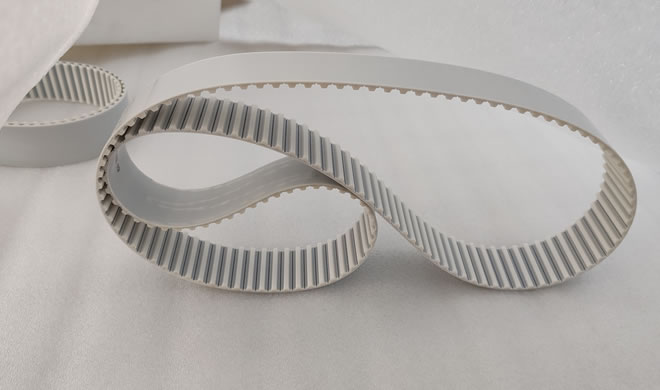
In general, open‑end timing belts are predominantly applied in linear motion systems, such as linear modules, gantry mechanisms, material‑handling equipment and automated production lines. Closed‑loop timing belts are designed for rotary transmission systems, including motor drives, reduction assemblies, conveyor machinery and various power‑transfer units. Therefore, belt construction shall be matched to the machine’s motion mode as the primary criterion, rather than selecting purely based on dimensions or procurement cost.
Open‑end timing belts feature an endless‑free strip without integrated splicing. They can be cut to custom lengths according to machine dimensions, with both ends clamped mechanically. This characteristic makes them ideal for long‑stroke linear transmission applications. Closed‑loop timing belts are manufactured as continuous integral loops with no open ends, enabling uninterrupted cyclic operation and making them well‑suited for rotary drives.
Open‑end timing belts are secured at two fixed mounting points of the machine. Driven by timing pulleys, they actuate sliding tables and moving assemblies to deliver linear displacement. Closed‑loop timing belts run continuously around paired pulleys, transmitting motor torque steadily to the driven shaft, which explains their widespread adoption across diverse rotary transmission systems.
Open‑end timing belts sustain persistent axial tension during operation, placing high demands on clamping hardware and mounting accuracy. Closed‑loop timing belts transfer torque via their loop structure with more evenly distributed stress, making them suitable for long‑term continuous cyclic duty. Additional distinctions cover installation procedures, tensioning solutions, maintenance requirements and feasible travel ranges. Comprehensive evaluation against actual operating conditions is essential for proper selection.
For mechanisms performing linear positioning, material transfer, workpiece handling or automated sliding tables, open‑end timing belts are generally the preferred option to satisfy long‑stroke and end‑clamping requirements. For machinery focused on rotary power transmission such as conveyors, packaging machines, printing equipment and general mechanical drives, closed‑loop timing belts deliver superior performance.
For applications demanding high positioning accuracy, engineers shall evaluate pitch accuracy, tensile strength and tensioning strategy, instead of only differentiating by open‑end or closed‑loop configuration. Meanwhile, working load, operating speed, acceleration and ambient conditions shall be taken into account to select suitable belt materials and reinforcement structures, such as steel cord or aramid fibre cores, to enhance transmission stability and service life.
Apart from belt construction, select proper specifications matching pulley tooth profile, belt width, pitch and allowable transmissible torque, to guarantee correct meshing between timing belt and pulleys.
During installation, set tension to an appropriate value. Excessive tension increases bearing burden, while insufficient tension causes tooth jumping, positioning deviation and unstable power transmission.
For dusty, high‑temperature or humid working environments, select belt materials compatible with ambient conditions and implement protective measures to mitigate contamination damage to belts and pulleys.
Perform routine inspection during equipment operation. Check for cracks, tooth face wear, reinforcement core damage and tension variation. Carry out timely tension adjustment or component replacement to sustain long‑term reliable performance of the transmission system.
There is no absolute superior or inferior option between open‑end and closed‑loop timing belts. The core evaluation standard lies in compatibility with machine motion mode and practical working conditions. Open‑end timing belts excel in linear transmission and long‑stroke positioning systems, whereas closed‑loop timing belts are optimised for continuous rotary power transfer. During component selection, comprehensively assess motion type, load magnitude, accuracy requirements, mounting layout and operating environment, instead of focusing merely on part dimensions, so as to achieve stable and dependable transmission performance.
Can open‑end timing belts be used for rotary transmission?
It is generally not recommended. Open‑end timing belts are engineered for linear motion systems; closed‑loop timing belts are the standard choice for rotary transmission scenarios.
Can closed‑loop timing belts be adopted for linear modules?
Special custom‑built structures allow such implementation. Nevertheless, the vast majority of linear modules utilise open‑end timing belts paired with clamping blocks to realise linear actuation.
Why must both ends of an open‑end timing belt be fixed?
Open‑end timing belts possess no loop structure. Mechanical clamps are required to fasten both ends so that linear reciprocating motion can be achieved under pulley drive.
Do these two types of timing belts deliver identical transmission accuracy?
With well‑matched specifications and correct installation, both can realise synchronous power transmission. Final achievable accuracy is further affected by tension level, mounting precision and mechanical rigidity of the host equipment.
How to extend the service life of timing belts?
Implement correct model selection, optimise belt tension, maintain pulley alignment, prevent contaminant ingress, and conduct periodic wear inspection. These measures play vital roles in prolonging timing‑belt service life.
Copyright © 2016-2025 Forrun (Guangdong) Industrial Technology Co., Ltd All Rights Reserved.