- Contact Us
- -
- Payment
- -
- 中文版
Knowledge Center · 2026-08-08 09:27:48 · 144 hits
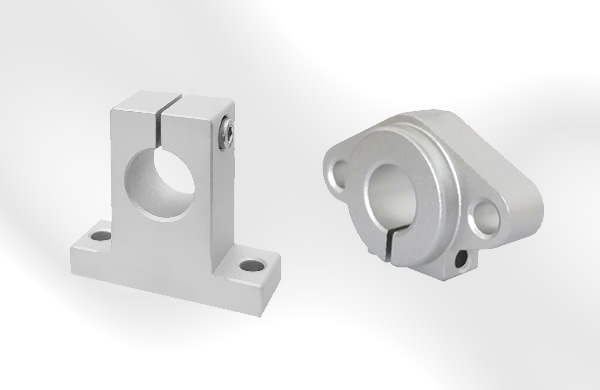
Guide shaft supports are not mandatory components for every machine. They are primarily deployed in linear‑motion mechanisms demanding high mounting precision, structural rigidity and convenient maintenance. Where equipment requires long‑stroke guidance, superior repeat positioning accuracy, or where guide shafts are subjected to substantial loads, shaft supports deliver a stable mounting base. They mitigate adverse effects caused by assembly misalignment and shaft deflection under force.For simple, light‑duty machinery whose frame already possesses sufficient machining flatness and positional accuracy, guide shafts can be mounted directly onto the machine frame without additional shaft supports.
In FA automation systems, guide shafts normally work in conjunction with linear bearings, sliding blocks, pneumatic cylinders and electric actuators. Motion accuracy directly determines overall equipment performance. Equipped with guide shaft supports, guide shafts can be firmly positioned, which helps guarantee parallelism and coaxiality between dual guide shafts and shortens assembly‑and‑commissioning time.Furthermore, supports simplify replacement and servicing work. Technicians can perform maintenance merely by detaching the supports, without re‑machining the main machine body. For these reasons, guide shaft supports are extensively used in automatic assembly stations, material‑handling mechanisms, inspection machines and tooling jigs & fixtures.
For long‑stroke guiding assemblies, shaft rigidity declines as shaft length increases. The shaft becomes more prone to deflection induced by self‑weight or external applied loads. Properly applied guide shaft supports enhance the rigidity of fixed mounting ends, reduce shaft offset and mechanical vibration, and enable smoother linear travel.When machinery bears considerable radial loads or impact shocks, such as material‑handling robots, lifting assemblies and heavy‑duty sliding tables, direct shaft mounting alone seldom sustains long‑term stability. Guide shaft supports improve overall joint strength and minimize loosening and positioning drift arising from prolonged cyclic loading.
Guide shafts may be fastened directly to the machine frame if the structural frame provides high‑precision, reliable mounting reference surfaces. Typical examples include compact test setups and light‑load mechanisms featuring short‑length guide shafts and low operating frequency. Direct mounting satisfies functional requirements while cutting part count and assembly costs.Even without shaft supports, designers must ensure adequate flatness, parallelism and clamping strength of mounting surfaces. Poor mounting quality will still compromise guiding accuracy and component service life.
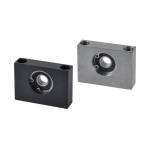
When specifying guide shaft supports, first confirm bore diameter matches the outer diameter of the guide shaft. Then evaluate mounting style, load magnitude and available installation space.Open‑clamp type supports are preferred for applications requiring frequent shaft disassembly, thanks to easy installation and servicing. For high‑rigidity requirements, select robust monolithic support constructions.Engineers shall also take support material, machining tolerance and fitting conditions against machine mounting surfaces into consideration. Even high‑quality guide shafts cannot deliver expected motion performance if the supports themselves suffer insufficient manufacturing precision.
Guide shaft supports are well‑suited for automated machinery, long‑stroke guiding systems, heavy‑duty motion units and equipment with strict mounting‑accuracy specifications. They improve mounting rigidity and positioning accuracy for guide shafts while streamlining commissioning and subsequent field maintenance.During component selection, make comprehensive assessments based on equipment load, travel stroke, installation constraints and maintenance requirements. Guide shafts do not always require supporting blocks; engineers shall strike a balanced solution among mechanical performance, budget and structural layout.
Not necessarily. Direct shaft fixation is acceptable for short‑stroke, light‑load machines with high‑accuracy mounting reference surfaces.
Yes. Supports enhance mounting precision and clamping rigidity, thereby boosting overall stability of the guiding mechanism.
Longer guide shafts are more susceptible to deflection and vibration. Shaft supports strengthen fixation and reduce operational positioning errors.
They are widely implemented in automated equipment, material‑handling mechanisms, tooling fixtures, inspection stations, lifting units and general linear‑motion systems.
Select proper dimensions and construction styles according to guide‑shaft diameter, mounting configuration, load conditions, installation space and equipment precision requirements.
Copyright © 2016-2025 Forrun (Guangdong) Industrial Technology Co., Ltd All Rights Reserved.