- Contact Us
- -
- Payment
- -
- 中文版
Knowledge Center · 2026-08-07 09:51:11 · 175 hits
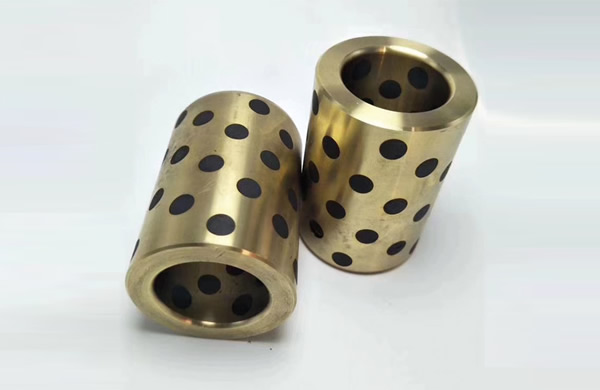
Direct metal‑to‑metal contact between shafts and bushings during mechanical movement generates considerable frictional resistance, accompanied by heat buildup, accelerated wear and increased operating clearances. Oil‑free bushings form a low‑friction contact interface during operation via internally embedded lubricant ingredients or surface lubricating layers, maintaining stable sliding conditions between shaft and bushing to mitigate direct metallic contact. Compared with conventional metallic bushings, oil‑free bushings do not rely on continuous replenishment of liquid lubricants. They can deliver consistent motion performance under operating environments where routine maintenance is inconvenient or liquid lubricants cannot be applied.
The friction‑reduction performance of oil‑free bushings originates from their specialized material construction. Typical oil‑free bushings are manufactured from copper‑alloy substrates, composite materials or matrices blended with solid lubricants. During cyclic motion, internal lubricant components gradually transfer onto frictional contact surfaces and build up a thin protective lubrication film between shaft and bushing. This film lowers interfacial frictional resistance and prevents direct metal contact for smoother operation. Conventional plain bushings may suffer surface abrasion caused by insufficient lubrication after prolonged running, whereas oil‑free bushings can sustain stable long‑term performance depending on the inherent lubricating properties of base materials.
In many automated machines, moving components are installed inside enclosed housings, heavily contaminated zones or positions with limited manual accessibility. Traditional plain bearings require periodic oil or grease replenishment; otherwise, operators will face rising friction, excessive temperature rise or even component seizure. Oil‑free bushings eliminate frequent lubrication top‑ups and effectively cut overall equipment maintenance workload. Typical implementations include sliding mechanisms on automated production lines, mold ejector assemblies and precision fixtures, where oil‑free bushings are deployed to lower maintenance demands. It should be noted that oil‑free bushings are not entirely maintenance‑free. Heavy dust contamination, foreign‑particle intrusion or overload operation will still accelerate bushing wear.
Compared with traditional bearing assemblies requiring regular greasing, the primary merit of oil‑free bushings lies in simplified lubrication management. For long‑running equipment, manual lubrication quality is subject to maintenance cycles and on‑site operational standards; delayed lubrication will degrade frictional conditions. Oil‑free bushings reduce dependence on human‑operated maintenance and improve overall equipment stability. Furthermore, minimal consumption of grease or oil makes them well‑suited for cleanliness‑critical scenarios such as food‑processing machinery, electronic‑manufacturing equipment and precision assembly stations. Nevertheless, oil‑free bushings are not universally optimal for every working condition from the perspective of load capacity and high‑speed performance. Engineers must evaluate actual operating parameters before specifying them for high‑speed, heavy‑load or ultra‑precision applications.
Despite outstanding anti‑friction characteristics, proper mating and configuration remain essential for oil‑free bushing performance. First, verify material selection and surface quality of mating shafts. Insufficient shaft surface hardness or excessive surface roughness will expedite bushing wear and shorten service life. Second, guarantee assembly accuracy. Angular misalignment during installation triggers uneven force distribution, resulting in localized pressure concentration, abnormal abrasive wear and even shaft seizure. In addition, select appropriate bushing specifications in accordance with equipment load and sliding velocity. Even self‑lubricating materials will suffer performance deterioration caused by excessive contact pressure or overheating when operated beyond their design limits.
Oil‑free self‑lubricating bushings form low‑friction interfacial films through lubricant components embedded within base materials, which reduces friction and wear during mechanical motion. In contrast to continuously lubricated traditional bearing structures, oil‑free bushings feature low‑maintenance requirements, excellent cleanliness and compatibility with harsh operating environments, and are widely adopted across diverse automated machinery and motion mechanisms. In practical deployment, component selection must take load magnitude, travel speed, installation precision and ambient conditions into full consideration to avoid premature wear or seizure induced by overloading or improper assembly.
Not exactly. Oil‑free bushings achieve lubrication mainly by material‑embedded solid lubricants. Auxiliary lubrication or periodic inspection may still be necessary under extreme working conditions.
Common root causes include excessive applied load, assembly misalignment, poor mating‑shaft surface quality and excessive operating temperature, all of which lead to elevated frictional resistance.
Performance depends on specific material grades and structural designs. Most oil‑free bushings are optimized for medium‑and‑low‑speed operation. Temperature rise and wear resistance must be thoroughly assessed for high‑speed applications.
Oil‑free bushings belong to sliding‑friction structures with simple construction and low maintenance overhead. Linear bearings adopt rolling‑contact principles to achieve lower motion resistance and are preferred for high‑precision linear travel applications.
They are widely applied in automated machinery, mold assemblies, jigs and fixtures, packaging equipment and general‑purpose mechanical sliding units where reduced maintenance is expected.
Copyright © 2016-2025 Forrun (Guangdong) Industrial Technology Co., Ltd All Rights Reserved.