- Contact Us
- -
- Payment
- -
- 中文版
Knowledge Center · 2026-11-25 09:17:38 · 22 hits
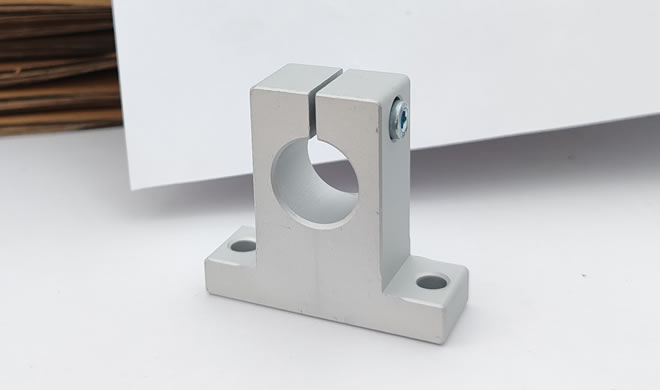
A guide shaft support is not mandatory in every linear mechanism. It becomes valuable where mounting accuracy, structural rigidity, and ease of maintenance matter—typically in long-stroke guidance, repeatability-critical positioning, or shafts carrying substantial loads. In those cases the support provides a stable mounting base and reduces the effects of installation error and deflection under load. On simple, lightly loaded equipment whose frame already offers sufficient accuracy, the shaft may be bolted directly to the frame without an additional support.
1. Which Applications Benefit Most
Guide shaft supports are most useful when the mechanism relies on precise alignment between two or more shafts. They give each shaft a defined, repeatable location and resist the shift that can occur when a shaft is clamped directly to an imperfect frame. This is especially important where the mechanism must hold parallelism and coaxiality over repeated assembly or after maintenance, and where the shafts are subjected to radial loads that would otherwise distort the mounting points.
For machinery with a rigid, precision-machined frame and short, lightly loaded shafts, the added support may bring little benefit. The decision should be based on the required accuracy and stiffness rather than on habit.
2. Why Automation Equipment Uses Them
In automation equipment, guide shafts normally work together with linear bearings, slide blocks, pneumatic cylinders, or electric actuators, and motion accuracy directly affects machine performance. A support fixes the shaft at a defined position, helping to maintain parallelism and coaxiality between two shafts and reducing installation and commissioning time.
Maintenance is the second major advantage. When a shaft needs replacement, only the support has to be released—there is no need to re-machine or re-drill the machine body. This is why supports are widely used in automated assembly machines, transfer mechanisms, inspection equipment, and fixtures and jigs, where downtime is expensive and repeatability is expected after every service.
3. Long-Stroke and Heavy-Load Mechanisms
Length is the decisive factor. Deflection grows rapidly with unsupported shaft length: for a cantilever under an end load, δ = FL³/(3EI), so doubling the free length multiplies deflection roughly eightfold; sag from the shaft's own weight on a simply supported span follows an even steeper L⁴ relationship. Correctly placed supports shorten the effective unsupported span and stiffen the shaft exactly where bending moment is greatest, reducing offset, vibration, and uneven bearing loading.
Under high radial loads or shock—handling machinery, lifting mechanisms, heavy-duty slide stages—direct mounting alone often cannot remain stable over time. A support raises joint strength and reduces loosening and positional drift caused by prolonged loading.
For long shafts, thermal growth also matters. A common arrangement is to hold one end firmly and let the opposite support act as a simple (floating) bearing—a fixed–supported scheme that accommodates expansion without over-constraining the shaft and bowing it.
4. When Supports Can Be Omitted
If the machine structure itself offers high machining accuracy and a reliable mounting datum, the guide shaft can be fixed directly to the frame. Small machines, laboratory rigs, and light-load mechanisms with short shafts and low cycle rates often fall into this category: direct mounting meets the requirement while reducing part count and assembly cost.
Even without a support, however, the mounting surface must still meet requirements for flatness, parallelism, and fixing strength. Poor surface quality will degrade guidance accuracy and shorten service life regardless of how good the shaft is.
5. Selection Considerations
Confirm the shaft diameter first, then choose the configuration according to mounting method, load, and available space. The main forms differ as follows:
| Support type | Characteristics | Best suited to |
|---|---|---|
| Solid (one-piece bore) support | Continuous material around the bore; highest rigidity and alignment stability | Heavy loads, precision guidance, permanent installation |
| Split / clamp-type support | Two-piece body secured by clamping screws; shaft can be removed without axial disassembly | Frequent removal or replacement, short-to-medium shafts |
| Side-mount or flange-type support | Mounting face adapted to restricted space or vertical installation | Compact equipment, side or inverted mounting |
If the shaft must be removed frequently, the split type is easier to install and service. Where rigidity is the priority, the solid form is preferable. Also check the support material, machining accuracy, and how it mates with the machine mounting surface. A support of inadequate accuracy will limit the whole mechanism even when the shaft itself is of high quality; fit between bore and shaft and the flatness of the mounting face should be verified, and locating pins are often used to preserve alignment after disassembly.
Summary
Guide shaft supports are most appropriate for automation equipment, long-stroke guidance, heavy-load motion systems, and machinery with high mounting-accuracy requirements. They improve shaft rigidity and positioning accuracy while simplifying installation, adjustment, and later maintenance. Final selection should weigh load, stroke, mounting conditions, and service needs together: not every shaft requires a support, and the right answer is the balance of performance, cost, and structure that fits the application.
FAQ
Does a guide shaft always need a support?
Not necessarily. For short-stroke, light-load equipment with an accurate mounting datum, the shaft can be fixed directly.
Can a shaft support improve motion accuracy?
Yes. It improves mounting accuracy and fixing rigidity, which in turn stabilises the guidance system.
Why are supports recommended for long shafts?
Longer shafts deflect and vibrate more easily. A support improves fixation and reduces running error.
Where are shaft supports commonly used?
In automation equipment, transfer mechanisms, fixtures and jigs, inspection machines, lifting mechanisms, and linear motion systems.
How should a shaft support be selected?
Choose by shaft diameter, mounting method, load conditions, available space, and the accuracy required of the equipment.
Copyright © 2016-2025 Forrun (Guangdong) Industrial Technology Co., Ltd All Rights Reserved.