- Contact Us
- -
- Payment
- -
- 中文版
Knowledge Center · 2026-11-23 09:45:27 · 13 hits
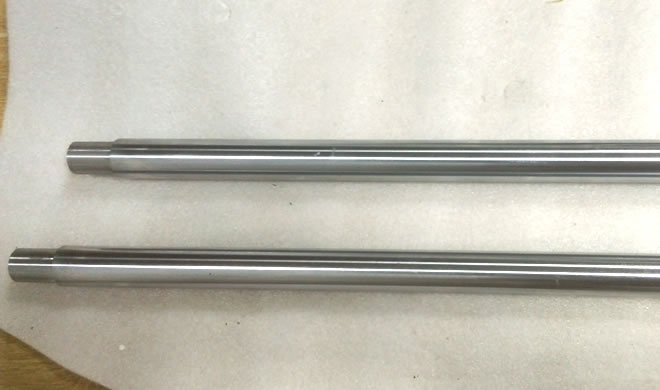
A guide shaft rarely generates noise on its own. In most cases the sound originates in the contact zone between the shaft and its mating element—a linear bearing, a bushing, or another sliding component. Continuous rubbing, a high-pitched squeal, or a periodic knock each points to a different fault, and treating all of them with the same remedy usually delays the real fix. This article breaks down the likely causes, the diagnostic clues, and the points to check when selecting a replacement shaft.
1. Why Guide Shafts Generate Abnormal Noise
The first step is to characterise the sound. Its behaviour with speed and position narrows the cause considerably:
| Symptom | Likely cause | First area to check |
|---|---|---|
| Continuous friction or rubbing sound | Insufficient or degraded lubrication; surface damage | Lubricant condition, shaft surface |
| Noise faint at low speed but marked at high speed | Lubrication, fit condition, mounting coaxiality | Lubricant, clearance, alignment |
| Sharp squeal or intermittent odd noise | Dry friction, contamination in excessive grease, overly tight fit | Lubricant type, contamination, fit clearance |
| One abnormal sound per revolution or at a fixed position | Localized wear, wear groove, corrosion, shaft bending | Straightness, surface condition, local damage |
| Rising noise together with higher drag and temperature | Eccentric mounting, side load, localized overload | Coaxiality, parallelism, bearing preload |
| Rattling or impact noise at high speed | Excessive clearance, loose mounting, bushing wear | Fit clearance, fasteners, mating component |
If the sound appears only after a specific travel position, look for local damage on the shaft. If it scales with speed, look at lubrication and alignment. If it repeats once per revolution, suspect a bent shaft or a localized defect on the rolling or sliding path.
2. Insufficient Lubrication and Contamination
For equipment using sliding bushings or linear bearings, lubrication state directly determines running noise. With insufficient lubricant, friction between shaft and mating part rises, producing dry-friction sounds or intermittent squealing.
More lubricant is not automatically better. If the wrong grease is selected, or if the environment contains dust and machining chips, excess lubricant acts as a trap: contaminants are captured at the contact zone and form an abrasive paste that accelerates wear of the mating surfaces. In such environments the correct approach is to clean before relubricating, select a grease with suitable consistency and additives, and protect the bearing with wiper seals or bellows.
3. Mounting Eccentricity and Misalignment
A guide shaft mounted out of alignment with its linear bearing or bushing is one of the most common noise sources in real equipment. If the two support positions are offset, the shaft carries an additional side load during travel, overloading one region of the mating part. Besides noise, this produces higher running resistance, sticking, and a temperature rise in the guide element.
Relubrication usually reduces the sound only temporarily, because it cannot remove the sustained side force caused by mounting eccentricity. The proper remedy is to check parallelism, coaxiality, and bearing-seat alignment. During assembly, the shaft should be seated freely; forcing it into misaligned housings preloads the bearing and creates the same problem from the start. Locating pins or shims are often used to bring supports into line.
4. Surface Wear on the Shaft and Mating Element
After extended service, a guide shaft may develop scratches, wear grooves, corrosion, or localized damage. As the surface condition deteriorates, contact with the guide element becomes uneven, generating periodic friction and vibration.
The mating linear bearing or bushing must be inspected at the same time. If the inside of the guide element is already worn, replacing the shaft alone will not fully eliminate the noise. When both show clear wear, judge the condition of the pair as a system: a new shaft running in a worn bushing will simply wear to match it, and the noise will return.
5. Fit Clearance: Too Tight or Too Loose
A reasonable fit clearance between shaft and guide element is essential. Too little clearance creates high friction and may lead to binding; too much allows the moving part to rock and impact, showing up as pronounced vibration noise at high speed.
When abnormal noise appears, therefore, the question is not only "is it too tight?" Check the shaft diameter, the bearing bore, and the accumulated wear to confirm whether the actual fit is still within an acceptable range. Shaft tolerance classes such as g6 or h6 are commonly specified with linear bearings, but the recommendation of the bearing manufacturer should always take precedence. Preloaded (zero-clearance) bearings remove play and improve repeatability, but they demand higher mounting accuracy and are less forgiving of misalignment.
6. Purchasing Advice
Select a guide shaft according to the guidance method, shaft diameter, effective length, mounting accuracy, and working environment. For high-speed reciprocating motion, prioritise straightness, surface finish quality, and compatibility with the chosen linear bearing or bushing. For precision positioning or long-term continuous operation, also consider shaft material, surface hardness, and surface treatment such as hard chrome plating or induction hardening.
When buying a replacement, do not order by diameter and length alone. Confirm the dimensions and wear condition of the original mating element, and check whether the previous failure was caused by wear, lubrication, or alignment—otherwise the new shaft may reproduce the same noise.
7. Common Misconceptions
One common misconception is that noise from a guide shaft can always be cured by adding lubricant. Insufficient lubrication certainly causes odd sounds, but eccentric mounting, an incorrect fit, and a worn guide element produce noise as well; extra grease may mask the symptom while the root cause remains.
Another is to inspect only the shaft and ignore the bearing or bushing. A guidance system is a matched pair. Wear or mounting error on either side will show up through the contact interface as guide-shaft noise.
FAQ
Q: What should be checked first when a guide shaft makes a rubbing sound?
A: Start with lubrication condition, mounting coaxiality, and the contact condition between the shaft and its mating element.
Q: Can a misaligned guide shaft produce noise?
A: Yes. Misalignment raises the side load, causing abnormal friction between the shaft and the bearing or bushing.
Q: What are the signs of shaft surface wear?
A: Periodic odd noise, increased running resistance, sticking, and localized vibration are typical.
Q: Is a smaller fit clearance always better?
A: No. Too little clearance increases friction and the risk of binding; the correct fit depends on the specific guidance arrangement.
Q: Should a noisy guide shaft be replaced immediately?
A: Not necessarily. First determine whether the noise comes from the shaft, the linear bearing, the bushing, or the mounting structure, then decide on repair or replacement.
Copyright © 2016-2025 Forrun (Guangdong) Industrial Technology Co., Ltd All Rights Reserved.