- Contact Us
- -
- Payment
- -
- 中文版
Knowledge Center · 2026-10-05 09:14:28 · 8 hits
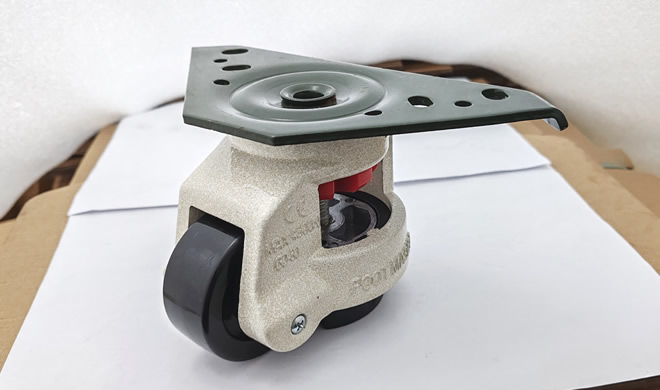
1. Definition and Function
1.1 Definition
A leveling caster is a mechanical component that combines mobility and stable support in one unit. It integrates a wheel for moving equipment with a built-in precision adjustment mechanism (a leveling foot) that varies the support height within a defined range. This lets the equipment be rolled into position and then leveled and locked, keeping it horizontal even on uneven floors.
1.2 Functions
Improved stability: Precise height adjustment keeps the equipment stable under any floor condition.
Equipment protection: Prevents tilt or damage caused by an uneven floor and extends service life.
Ease of operation: The user adjusts height quickly via a simple knob or handle — no special tools required.
2. Classification and Operating Principle
2.1 Classification
Manual type: Height is adjusted with a knob or handle; suited to applications that need frequent adjustment.
Electric type: Driven by a motor for automatic adjustment; suited to highly automated production lines.
| ype | Adjustment | Best for |
|---|---|---|
| Manual | Knob / handle | Frequent manual adjustment, lower cost |
| Electric | Motor-driven | Automated lines, remote / synchronized leveling |
2.2 Operating Principle
Screw-lift mechanism: A lead screw converts rotary motion into linear motion to raise or lower the support, delivering fine, controlled height changes.
Self-locking: A built-in self-locking feature holds the adjusted position so it does not shift under vibration or external force.
3. Load and Adjustment-Travel Selection
Choose the caster series against the actual load per caster and the leveling travel your floor requires. As a rule of thumb, divide the total equipment weight by the number of casters, then apply a safety factor of 1.3–1.5. Note the distinction: while rolling, the wheel carries the load (dynamic rating); once the leveling foot is engaged and the equipment is lifted off the wheels, the foot carries the load (static rating). Both ratings should be checked.
| Load per caster | Typical wheel Ø | Adjustment travel | Recommended use |
|---|---|---|---|
| Light ≤ 150 kg | 50–75 mm | 10–20 mm | Lab benches, small instrument carts |
| Medium 150–400 kg | 75–100 mm | 15–30 mm | Medical carts, instrument racks |
| Heavy 400–800 kg | 100–125 mm | 20–40 mm | Production equipment, CNC peripherals |
| Extra-heavy 800–1500 kg | 125–150 mm | 30–50 mm | Large machine tools, heavy lines |
*Values are typical reference ranges; confirm exact ratings on the manufacturer's datasheet. Select travel to cover the worst-case floor unevenness plus a margin.
Sizing checklist
Total equipment weight ÷ number of casters = load per caster.
Multiply by 1.3–1.5 safety factor; pick a caster rated above it.
Confirm dynamic (rolling) and static (foot-engaged) ratings separately.
Choose travel ≥ expected floor unevenness + margin.
Match wheel material to floor type (e.g., non-marking for clean rooms).
4. Installation and Maintenance
4.1 Installation Points
Choose the right positions: Mount the casters at the equipment's key support points to distribute weight and maintain balance.
Check the floor: Inspect floor flatness before installation and perform preliminary correction if necessary.
4.2 Maintenance Recommendations
Periodic inspection: Regularly check caster fasteners for looseness and retighten promptly.
Cleaning: Keep the caster surfaces clean so dust and debris do not degrade adjustment precision.
5. Application Cases
5.1 Manufacturing
Automated production lines: In automotive manufacturing, electronics assembly, and similar lines, leveling casters keep equipment in its optimal operating state.
Precision machining equipment: High-accuracy machines such as CNC machine tools and laser cutting machines must remain absolutely level on uneven floors to guarantee machining precision.
5.2 Medical Industry
Medical equipment: Large devices such as X-ray machines and CT scanners require both stability and mobility in hospital environments; leveling casters are an ideal choice.
5.3 Laboratories
Laboratory benches: Various lab benches must stay level to ensure accurate experimental data; leveling casters meet this requirement.
Copyright © 2016-2025 Forrun (Guangdong) Industrial Technology Co., Ltd All Rights Reserved.