- Contact Us
- -
- Payment
- -
- 中文版
Knowledge Center · 2026-08-22 09:48:06 · 170 hits
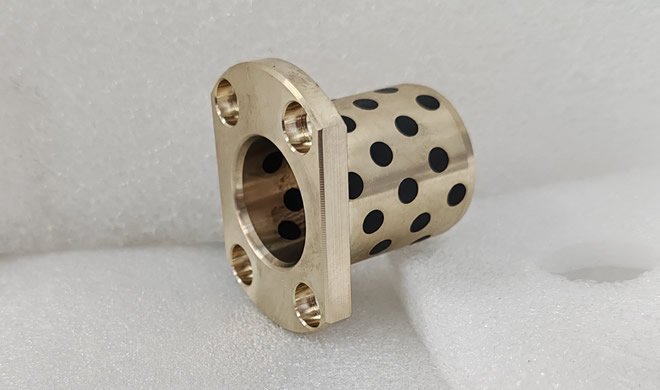
Oil‑free bushings are sliding support components operating with self‑lubricating composites or solid lubricant layers. They enable low‑speed, heavy‑load operation without frequent grease or oil replenishment.
Compared with conventional rolling bearings, oil‑free bushings deliver superior performance under the following operating conditions:
High applied loads
Low‑speed reciprocating motion
Dusty and contaminated surroundings
Hard‑to‑access locations for routine servicing
Thanks to these characteristics, oil‑free bushings have gained expanding adoption across automated machinery, construction equipment and heavy‑duty conveying systems.
Within heavy‑duty equipment, traditional rolling‑element structures are subject to several inherent drawbacks:
Excessive local contact stressBall or roller elements are prone to fatigue spalling under concentrated pressure.
High reliance on continuous lubricationWear accelerates rapidly once lubricant supply becomes insufficient.
Limited contamination resistanceIngress of dust and solid particles easily damages rolling elements and raceways.
Poor tolerance against shock loadsRepetitive impact shocks shorten service life significantly.
These failure modes raise maintenance frequency and increase unplanned‑downtime risks for production systems.
Oil‑free sliding bushings exhibit distinct strengths versus rolling‑bearing solutions for heavy‑duty scenarios:
Enhanced load capacity via surface contactThe full‑area sliding interface effectively disperses localized contact pressure.
Optimized for low‑speed heavy‑load serviceSurface contact avoids the fatigue pitting commonly observed on rolling elements.
Improved contamination toleranceLess sensitive to dust, debris and fine particulate pollutants.
Reduced maintenance overheadFrequent relubrication is eliminated, well‑suited for long‑running production equipment.
Reliable shock‑load resistanceSolid composite structure prevents catastrophic rolling‑element damage during transient impact events.
For the above reasons, numerous heavy‑duty machines are migrating from rolling‑element designs toward sliding‑support solutions based on oil‑free bushings.
Select bushing material according to the PV value (pressure × velocity), a critical evaluation index for sliding bearings.
Control surface roughness and surface hardness of the mating shaft to form stable sliding interfaces.
Prevent installation misalignment which causes uneven partial wear on bushing inner surfaces.
Deploy high‑temperature‑grade composite materials for elevated‑temperature working environments.
Apply an increased safety factor for applications subjected to frequent impact loads.
Although oil‑free bushings are capable of sustaining heavy loads, satisfactory service performance still relies on proper loading conditions and precise fitting tolerances.
Misconception 1: Oil‑free bushings require zero maintenancePeriodic inspection for progressive wear and clearance variation is still necessary throughout service life.
Misconception 2: Oil‑free bushings fit every heavy‑load applicationThey are generally not recommended for continuous high‑speed operating conditions.
Potential risk: Exceeding allowable PV limits or severe eccentric loading will result in accelerated abrasive wear, and in worst‑case scenarios, shaft seizure.
Q1: Can oil‑free bushings fully replace rolling bearings?
A: No. Rolling and sliding supports each serve distinct working conditions; component selection shall match actual application requirements.
Q2: Why are oil‑free bushings preferred for heavy‑load and low‑speed scenarios?
A: Under low‑speed operation, rolling bearings struggle to build up a stable hydrodynamic lubrication film, which raises wear risk for rolling‑element assemblies.
Q3: What factors dominate the service life of oil‑free bushings?
A: Service life is determined by combined influences including applied load magnitude, sliding velocity, bushing material grade, and mechanical installation accuracy.
Copyright © 2016-2025 Forrun (Guangdong) Industrial Technology Co., Ltd All Rights Reserved.