- Contact Us
- -
- Payment
- -
- 中文版
Knowledge Center · 2026-10-17 09:34:10 · 4 hits
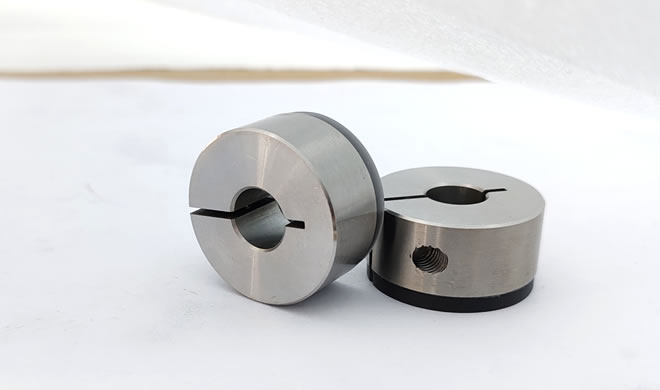
1. What Is a Shaft Collar in Heavy-Duty Service
A shaft collar is a mechanical fastener used for axial positioning and stopping on shafts, in bores, or within transmission structures. In heavy-duty service, however, a collar does far more than locate a part: it must also sustain significant axial loads and impact (shock) forces, so its specification and fit become load-bearing decisions rather than afterthoughts.
2. Why Heavy Duty Causes Problems
(1) Load exceeds capacity. An undersized collar can deform or jump out of its groove (disengagement).
(2) Impact loads. Frequent start-stop or shock duty accelerates fatigue damage.
(3) Poor groove machining. Incorrect groove depth, width, or fillet radius lowers the effective strength.
(4) Insufficient material strength. Standard carbon-steel collars can fail under high loads.
Failure-mode quick reference:
| Cause | Typical symptom | Remedy |
|---|---|---|
| Overload | Deformation, groove disengagement | Upsize collar; add safety factor |
| Impact / shock | Fatigue cracking, loosening | Raise specification; add auxiliary stop |
| Bad groove geometry | Local cracking at fillet | Machine groove to standard; relieve stress concentration |
| Weak material | Yielding, fracture | Switch to spring / alloy steel |
3. How to Select the Right Shaft Collar
(1) Verify the axial load first. Calculate the actual axial force from the duty and apply a safety factor.
(2) Choose a high-strength material. For heavy duty, specify spring steel or high-strength alloy steel.
(3) Optimize the mounting structure. Keep groove dimensions to standard to avoid localized stress concentration.
(4) Account for shock and vibration. Under impact, increase the specification grade or add an auxiliary limiting structure.
Material selection guide:
| Material | Strength | Best for |
|---|---|---|
| Carbon steel (general) | Baseline | Light-duty only |
| Spring steel | High yield, fatigue-resistant | Heavy / impact duty |
| High-strength alloy steel | Highest | Severe heavy-duty service |
| Stainless (e.g., SUS304 / 440C) | Moderate, corrosion-resistant | Corrosive or washdown environments |
4. Selection Precautions
Match the standard size to the shaft or bore diameter.
Ensure the collar thickness is compatible with the groove dimensions.
In corrosive environments, specify rust-proof / corrosion-resistant treatment.
In high-frequency vibration, add an anti-loosening design (e.g., clamping collar, thread-locking, or setscrew with patch).
Selection checklist:
Axial load calculated with safety factor
Material grade matched to duty (spring / alloy steel for heavy)
Groove machined to standard depth/width/fillet
Anti-loosening and corrosion provisions applied where needed
5. Risks and Common Misconceptions
| Misconception / risk | Reality |
|---|---|
| "A collar only positions parts." | Under heavy duty it bears large axial force |
| "Right size is enough." | Wrong material / strength still causes failure |
| Ignoring groove strength | Poor groove machining causes cracking or disengagement |
6. FAQ
Q1: Can I use a standard collar in heavy-duty service? Not recommended — use a high-strength or heavy-duty type.
Q2: Can a deformed collar still be used? No. Deformation means its load capacity has already dropped significantly.
Q3: How do I improve collar reliability? Correct material selection, standardized machining, and controlled impact loads are the keys.
7. Clamp-Type vs. Setscrew Collars
The two dominant collar styles behave very differently under load — and the choice matters most in heavy duty.
| Criterion | Clamp-type collar | Setscrew (grub-screw) collar |
|---|---|---|
| Holding mechanism | Split body clamped by screw(s) | Point contact pressing shaft |
| Axial holding force | High | Lower |
| Shaft damage | None (even clamping) | Can mar / dent the shaft |
| Vibration resistance | Excellent (low loosening risk) | Needs thread-lock; higher loosening risk |
| Reusability | High (no shaft damage) | Lower (shaft marked) |
| Cost | Slightly higher | Lower |
| Best use | Precision, heavy, vibrating duty | Light, non-critical duty |
For heavy-duty and high-vibration service, the clamp-type collar is the preferred choice.
8. Axial Load – Safety Factor – Size Quick Reference
Sizing logic. First compute the required capacity:
C_req = F_axial × SF
where F_axial is the applied axial load and SF the safety factor (1.5 general; 2–3 for heavy / impact duty). Choose a collar whose rated capacity meets or exceeds C_req.
Representative selection guide (reference values — always confirm against the manufacturer's catalog):
| Applied axial load F_axial | Recommended collar | Safety factor |
|---|---|---|
| < 1 kN | Carbon-steel standard collar | 1.5 |
| 1 – 5 kN | Spring-steel clamp collar | 2 |
| 5 – 15 kN | High-strength alloy clamp collar | 2 – 3 |
| > 15 kN | Heavy-duty / custom collar | 3+, auxiliary stop mandatory |
Practical notes:
Where shock or frequent reversing occurs, move up one tier and/or add an auxiliary stop.
For corrosive or washdown duty, specify stainless (SUS304 / 440C) even if it means up-sizing to recover strength.
Verify the rated capacity against the actual shaft hardness — soft shafts lower the achievable holding force.
Copyright © 2016-2025 Forrun (Guangdong) Industrial Technology Co., Ltd All Rights Reserved.