- Contact Us
- -
- Payment
- -
- 中文版
Knowledge Center · 2026-07-27 10:10:24 · 319 hits
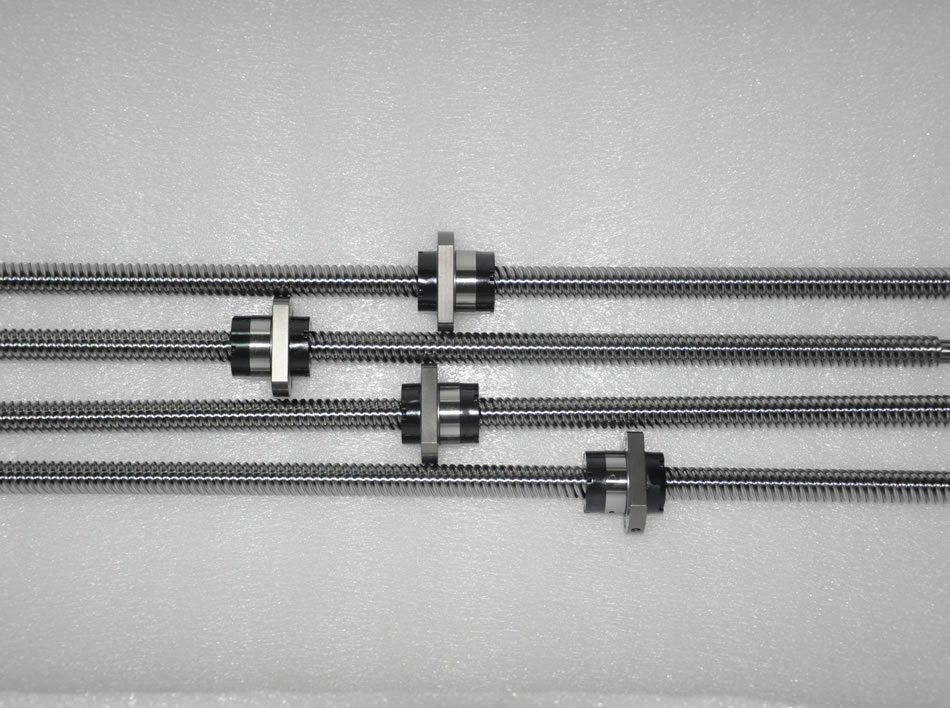
A ball screw is a mechanical transmission component that converts rotary motion into linear axial motion, or reversely converts linear motion into rotary motion. A complete ball screw assembly consists of a ball screw shaft, a ball screw nut (equipped with a ball recirculation system), and steel balls.
The slenderness ratio of a ball screw refers to the ratio between the effective shaft length and the shaft outer diameter.
1.Under normal operating conditions with rotational speed ranging from 1500 rpm to 2000 rpm, the recommended maximum slenderness ratio for single-start ball screws is 60, while that for double-start ball screws shall not exceed 40.
2.Excessively high slenderness ratio will degrade the positioning accuracy of the ball screw. If the rotational speed is not reduced accordingly, dangerous shaft resonance will occur, resulting in increased abnormal noise, shortened service life, and in severe cases, permanent shaft deformation and complete failure.
3.The recommended slenderness ratios are empirical summaries from historical engineering calculations, enabling engineers to complete rapid preliminary selection under similar operating conditions. For applications requiring higher rotational speeds or complex working environments, relevant operating parameters must be substituted into the allowable rotational speed formula to accurately calculate the required shaft diameter, allowable load and service life.
4.Operating Noise of Ball ScrewsNoise generation is inevitable during ball screw operation. Under identical load and rotational speed, ball screws of different accuracy grades and manufacturing processes deliver distinct noise performance:
5.Within the allowable load range and at 1500~2000 rpm: Rolled C7 ball screws produce approximately 75 dB noise; C10-grade ball screws generate noise above 80 dB; ground ball screws achieve roughly 60 dB noise level.
6.Noise level rises with increased load and rotational speed. If strict precision control is not required and higher travel speed is needed, selecting a ball screw with larger lead can improve overall operational stability and reduce noise.
Accuracy Grade: C10 < C7 < C5 < C3. Smaller numerical value represents higher precision and higher manufacturing cost.Rolled C7 ball screws are the most widely used grade and serve as the default selection for general applications. Ground C5 ball screws are the mainstream choice for high-precision scenarios. Normally, the price of C5-grade ball screws is 2~3 times that of C7-grade products.
Shaft Diameter: Outer diameter of the screw thread. Shaft diameter is determined by design load requirements. Ball screw loads include dynamic load and static load; dynamic load is the primary reference for design. From the service life perspective, the actual operating load shall be less than the rated dynamic load of the screw. Avoid continuous full-load operation and reserve sufficient load margin.
Lead: Linear travel distance of the nut per full rotation of the screw shaft. Lead correlates directly with design travel speed.Recommended operating speed for ball screws: <1500 rpm. If noise is not a priority constraint, the maximum rotational speed can reach 2000–2500 rpm.
Two key parameters related to lead:① Pitch (P): Axial distance between corresponding points of adjacent thread crests measured on the generatrix of the pitch cylinder.② Number of starts (n): Quantity of independent thread helices. For manufacturing convenience, n ≤ 4 in most cases.Formula: Lead = Pitch × Number of Starts, expressed as (S=n×P)
Length: Effective thread length and overall shaft length. Determine the design stroke first, then confirm the effective thread length, followed by the total shaft length.Reference slenderness limit: 60, meaning maximum screw shaft length < Shaft Diameter × 60.Material length restrictions:① Shaft diameter ≤ φ10: Maximum raw material length 1 m② Shaft diameter φ12 ~ φ20: Maximum raw material length 3 m③ Shaft diameter > φ20: Maximum raw material length 6 m
Shaft End Machining: Defines dimension F (length of coupling mounting section) and dimension P (diameter of coupling mounting section). For optimal performance: shorter F length and larger P diameter are preferred.
a. Lead accuracy of ball screws is controlled in accordance with JIS B 1192-1997 standard.b. Accuracy grades C1~C5 are defined by linearity and directional property. Grades C7~C10 are evaluated based on travel distance error measured over an effective travel length of 300 mm. (Refer to the corresponding tolerance values for each accuracy grade below.)
| Effective Thread Length (mm) | Ground Ball Screw | Rolled Ball Screw | ||||||
|---|---|---|---|---|---|---|---|---|
| C1 | C3 | C5 | C7 | C10 | ||||
| Nominal Travel Distance Error (±) | Travel Variation | Nominal Travel Distance Error (±) | Travel Variation | Nominal Travel Distance Error (±) | Travel Variation | Travel Distance Error | Travel Distance Error | |
| 0~100 | 3.5 | 5 | 8 | 8 | 18 | 18 | ±50 μm/300mm | ±210 μm/300mm |
| 100~200 | 4.5 | 5 | 10 | 8 | 20 | 18 | ||
| 200~315 | 6 | 5 | 12 | 8 | 23 | 18 | ||
| 315~400 | 7 | 5 | 13 | 10 | 25 | 20 | ||
| 400~500 | 8 | 5 | 15 | 10 | 27 | 20 | ||
| 500~630 | 9 | 6 | 16 | 12 | 30 | 23 | ||
| 630~800 | 10 | 7 | 18 | 13 | 35 | 25 | ||
| 800~1000 | 11 | 8 | 21 | 15 | 40 | 27 | ||
| 1000~1250 | 13 | 9 | 24 | 16 | 46 | 30 | ||
| 1250~1600 | 15 | 10 | 29 | 18 | 54 | 35 | ||
| 1600~2000 | 18 | 11 | 35 | 21 | 65 | 40 | ||
| 2000~2500 | 22 | 13 | 41 | 24 | 77 | 46 | ||
| 2500~3150 | 26 | 15 | 50 | 29 | 93 | 54 | ||
| 3150~4000 | 30 | 18 | 60 | 35 | 115 | 65 | ||
| 4000~5000 | 72 | 41 | 140 | 77 | ||||
| 5000~6300 | 90 | 50 | 170 | 93 | ||||
| 6300~8000 | 110 | 60 | 210 | 115 | ||||
| 8000~10000 | 260 | 140 | ||||||
| 10000~12500 | 320 | 170 | ||||||
| Unit: μm | ||||||||
Copyright © 2016-2025 Forrun (Guangdong) Industrial Technology Co., Ltd All Rights Reserved.