- Contact Us
- -
- Payment
- -
- 中文版
Knowledge Center · 2026-10-27 09:29:02 · 7 hits
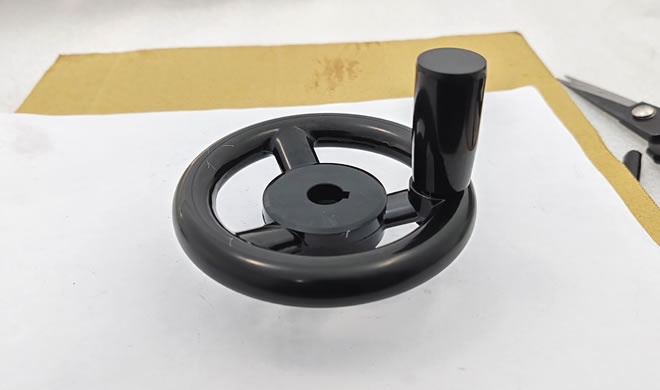
1. Why Handwheel Diameter Affects Operating Force
When a handwheel is turned, it generates torque through a rotating lever arm to overcome the resistance of the mechanism. A larger handwheel diameter places the operator's force further from the rotation center, so the same hand force produces a larger torque — and the operating force needed to drive the same load drops. Conversely, a smaller diameter shortens the lever arm; to reach the same output torque the operator must push harder, which causes fatigue over extended use. That is why mechanisms with frequent adjustment or heavy loads typically use a larger-diameter handwheel to lower operating resistance.
2. The Diameter–Torque Relationship
The driving torque of a handwheel depends on the operating force and the radius of action:
T = F × r = F × (D / 2)
where T is torque, F the hand force, r the radius, and D the handwheel diameter.
When a mechanism needs a larger adjustment torque, increasing the diameter lengthens the lever arm so the operator achieves it with less force. Screw-lift units, clamping mechanisms, and large adjustment devices carry high internal friction or load and therefore demand a large input torque — too small a handwheel feels noticeably heavy. But the diameter is not unlimited: an oversized wheel increases space occupation and reduces operational flexibility.
Worked example. To deliver T = 50 N·m:
At D = 200 mm (r = 0.10 m): F = 50 / 0.10 = 500 N
At D = 400 mm (r = 0.20 m): F = 50 / 0.20 = 250 N
Doubling the diameter halves the required hand force — the core reason larger wheels feel easier.
3. Choosing Diameter by Application
| Application | Recommended diameter | Reason |
|---|---|---|
| Precision adjustment | Not too large | Large wheel raises displacement per unit angle, hurting fine control |
| High-force mechanisms (clamping, lift, manual positioning) | Larger | Reduces operator burden under high torque demand |
| Space-constrained equipment | Balanced | Trade off operating force against installation space |
4. Does Material and Structure Affect the Experience?
Beyond diameter, structure changes the actual feel:
A revolving handle (rotating grip on the rim) lets the operator apply force by holding the handle — ideal for frequent rotation.
Surface texture, anti-slip design, and material hardness affect force efficiency; an overly smooth surface slips and raises the effective operating force.
Weight and moment of inertia also matter: a larger wheel lowers sustained force but needs more effort to start spinning.
5. Commonly Overlooked Issues
Bigger is not automatically easier. If the internal drive jams, lacks lubrication, or is wrongly assembled, a larger diameter only masks the symptom.
A larger wheel is not always right for precision. In high-repeatability positioning, excess torque can dull the operator's perception of small changes.
Selection must weigh operating frequency, adjustment torque, space limits, and precision together.
6. Purchasing Advice
Do not choose by mounting bore size alone. Confirm diameter, mounting method, rotation method, and load requirement against real use. For frequent manual adjustment, prioritize comfort and anti-slip performance; for heavy-load adjustment, prioritize a larger diameter that supplies enough torque. Also verify the fit with the connecting shaft, lead screw, or mechanism — excessive mounting clearance degrades adjustment precision.
7. Risks and Misconceptions
| Misconception | Reality |
|---|---|
| Bigger wheel always improves adjustment | It raises space need and lowers speed; not for every case |
| Difficulty must be a size problem | Internal resistance, poor lubrication, or worn parts won't be fixed by a bigger wheel |
8. Quick Reference: Diameter vs. Operating Force
From F = 2T / D, the hand force for any torque–diameter combination can be estimated directly:
| Required torque T (N·m) | D = 150 mm | D = 200 mm | D = 250 mm | D = 300 mm | D = 400 mm |
|---|---|---|---|---|---|
| 5 | 67 N | 50 N | 40 N | 33 N | 25 N |
| 10 | 133 N | 100 N | 80 N | 67 N | 50 N |
| 20 | 267 N | 200 N | 160 N | 133 N | 100 N |
| 50 | 667 N | 500 N | 400 N | 333 N | 250 N |
Suggested force limits by duty (ergonomic guideline, not a hard standard):
| Duty pattern | Suggested maximum hand force |
|---|---|
| Frequent adjustment (every few minutes) | ≤ 50 N |
| Intermittent adjustment | ≤ 80 N |
| Rare, heavy adjustment | ≤ 120 N (brief effort) |
If the computed force exceeds the limit for the duty, increase the diameter, add a revolving handle, reduce mechanism friction, or move to a crank / gear reduction / power assist.
9. Revolving Handles and Cranks: Structure and Torque Gain
A plain rim forces the operator to regrip after every arc of movement, which slows continuous rotation and accelerates fatigue. A revolving handle — a grip mounted on the rim or a spoke that spins freely on a stud (plain bushing or ball-bearing) — lets the operator drive the wheel with a closed fist in continuous motion. Fold-away handles pivot flat against the wheel when idle, saving space and preventing snagging.
Note that the revolving handle does not lengthen the lever arm: the grip sits essentially at the rim radius, so the theoretical torque at a given force is unchanged. The gain is purely ergonomic — better grip, tangential force applied efficiently, no regripping — which in practice raises the torque an operator can comfortably sustain and cuts fatigue on multi-turn adjustments.
| Type | Effective lever arm | Best for | Limitation |
|---|---|---|---|
| Plain-rim handwheel | D / 2 | Occasional adjustment | Regripping needed; hard to spin continuously |
| Handwheel + revolving handle | ≈ D / 2 (at the grip) | Frequent multi-turn adjustment | Protruding grip needs clearance (fold-away mitigates) |
| Crank handle | Crank-arm length | High torque, limited-angle moves | Not suited to smooth continuous multi-turn |
When specifying a revolving handle, check grip diameter and length (hand size and comfort), stud mounting, bearing type, grip material (phenolic, plastic, steel), and fixed vs. fold-away.
10. A Practical Selection Workflow
Determine the required input torque T of the mechanism — from friction/load calculation or by measurement with a torque wrench on the shaft.
Set the maximum acceptable hand force F_max from the duty-frequency guideline in Section 8.
Compute the minimum diameter: D_min = 2T / F_max.
Round up to a standard diameter (150 / 200 / 250 / 300 / 400 mm…), then check installation space and precision needs. For precision axes, prefer a moderate wheel with a graduated dial or fine-adjustment knob rather than an oversized wheel.
Verify the fit: mounting bore, keyway or setscrew, shaft tolerance — excessive mounting clearance shows up directly as lost motion at the rim.
If D_min exceeds roughly 400–500 mm, a plain handwheel is no longer practical: switch to a crank handle, add gear reduction, cut the mechanism's internal resistance, or consider power assist.
Worked example. A screw-lift table needs T ≈ 5 N·m and is adjusted frequently:
F_max = 50 N → D_min = 2 × 5 / 50 = 0.20 m = 200 mm
A 200 mm wheel gives F = 2 × 5 / 0.2 = 50 N — exactly at the limit, acceptable
If the same mechanism needed T = 10 N·m, D_min would become 400 mm; where space does not allow that, reduce internal friction or use a geared handwheel rather than forcing the operator to push 100 N.
11. FAQ
Q: Is a larger diameter always easier to turn? Within the same mechanism resistance, yes — a larger radius yields more torque, so operating force drops.
Q: What is a small-diameter wheel for? Space-limited equipment, low-load adjustment, or fast-operation devices.
Q: Should precision mechanisms use a large wheel? Not necessarily. Precision cares about control feel and adjustment accuracy; size to the actual need.
Q: Why does it still feel heavy after enlarging? Likely internal resistance — worn screw, insufficient lubrication, or assembly error — not the wheel size.
Q: Does a revolving handle increase torque? It does not lengthen the lever arm, but the better grip and continuous motion raise the torque an operator can comfortably deliver and reduce fatigue.
Q: What else matters besides diameter? Mounting bore, material, structure type, rotation method, and operating environment.
Copyright © 2016-2025 Forrun (Guangdong) Industrial Technology Co., Ltd All Rights Reserved.