- Contact Us
- -
- Payment
- -
- 中文版
Knowledge Center · 2026-10-22 09:32:37 · 4 hits
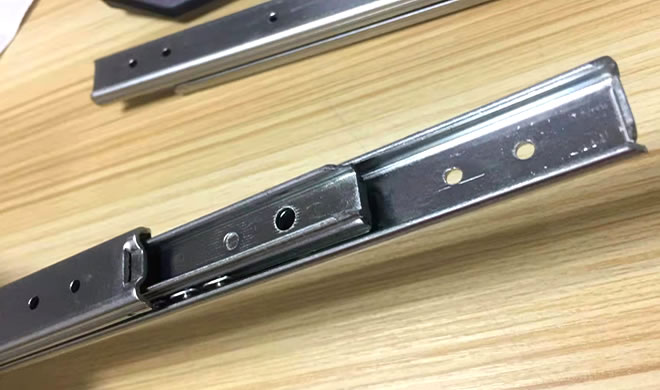
1. Application Characteristics
Medium-duty telescopic slide rails are widely used in industrial control cabinets, logistics equipment, medical instruments, and various medium-size machinery drawer systems, with a typical load capacity of 50–100 kg. Beyond stable load-bearing, they demand high guiding precision, smoothness, and service life. Insufficient precision leads to drawer wobble, sticking (jamming), and positioning deviation — and in severe cases compromises equipment safety.
| Application sector | Typical use | Why precision matters |
|---|---|---|
| Industrial control cabinet | Equipment / wiring drawers | Stable positioning; no play under vibration |
| Logistics equipment | Pull-out racks, compartments | Smooth travel under repeated load |
| Medical instruments | Instrument / module drawers | Accurate, repeatable positioning |
| Medium machinery | Tool / component drawers | Long life under 50–100 kg load |
2. Core Factors That Affect Slide Precision
2.1 Rail Body Structure and Manufacturing Tolerance
Quality slides are typically formed from cold-rolled steel plate or stainless steel by high-precision tooling. The ball raceway machining tolerance should be held within ±0.1 mm. Higher rail rigidity translates directly into more stable travel.
2.2 Mounting Plane and Positioning Consistency
The mounting surfaces on both sides must be parallel, and the mounting-hole positions must match precisely. If the drawer body and the cabinet side panel are out of sync or installed skewed, the two rail sides share load unevenly — causing wear, wobble, and even jamming.
2.3 Ball System Quality
The balls are the transmission medium and directly determine travel smoothness. Precision steel balls offer higher rolling consistency and wear resistance, markedly improving the slide's overall precision and stability.
2.4 Screw Tightening Force and Sequence
Tighten screws in the manufacturer-recommended sequence — from the center outward to both ends — to keep the rail fully seated and avoid local deformation that would degrade precision.
Factor-to-effect summary:
| Factor | Poor condition | Consequence |
|---|---|---|
| Raceway tolerance | > ±0.1 mm | Wobble, rough travel |
| Mounting parallelism | Surfaces not parallel | Uneven load, jamming |
| Ball quality | Inconsistent / worn balls | Noise, positioning error |
| Tightening sequence | Wrong order / over-tight | Local deformation, lost precision |
Note: "Telescopic slide rail" usually refers to a ball-bearing, multi-section (typically 3-section full-extension) slide. The ±0.1 mm raceway tolerance cited here is the rail's own machining spec — final installed precision also depends heavily on the points in §2.2–2.4, which are within the assembler's control.
3. Practical Recommendations for Ensuring Precision
Choose branded, certified products. Prefer well-known slides with ISO quality certification and ground (machined) ball raceways rather than simply stamped tracks.
Confirm the installation environment. The mounting surface must be flat, free of burrs, and free of protruding weld beads. Before installation, check the cabinet's straightness with a spirit level.
Measure and locate holes precisely. Use a dedicated mounting jig or laser positioning system for drilling and fixing to raise alignment accuracy.
Lubricate and maintain. Add grease regularly and clear away debris; fine particles damage balls and increase running error.
Use a preload structure where available. Some high-end slides feature a preload (preloading) design that eliminates clearance and further raises running precision.
Installation precision checklist:
Mounting surfaces cleaned, flat, burr- and weld-free
Cabinet straightness verified with a level
Holes located with jig / laser, both sides matched
Screws tightened center → ends, to spec torque
Slide seated evenly, no skew
Greased; preload type confirmed if specified
4. Summary
Precision of a telescopic slide rail is not decided by the rail alone — it is the product of material and raceway quality, consistent installation, correct fastening, and ongoing maintenance. Following the recommendations above keeps drawer systems stable, smooth, and safe across their service life.
5. Load × Cross-Section Height × Section Count — Selection Guide
Heavier loads need a taller rail profile (more material and rigidity) and, for deep drawers, full-extension sections. Values below are reference ranges — confirm against the specific catalog.
| Load capacity | Profile height | Sections | Typical application |
|---|---|---|---|
| ≤ 35 kg | 27 – 35 mm (low profile) | 2 or 3 | Light drawers, shallow units |
| 35 – 100 kg | 35 – 50 mm | 3 (full extension) | Medium-duty (this article's range) |
| 100 – 150 kg | 50 – 60 mm | 3 | Heavy tool / component drawers |
| 150 – 250 kg | 60 – 76 mm | 3 (heavy) | Heavy industrial drawers |
For the 50–100 kg class, a 45–50 mm, 3-section slide is the common default; step up the profile height if the drawer is deep or subjected to side loading.
6. Full-Extension (3-Section) vs. Partial-Extension (2-Section)
| Criterion | 2-section (partial) | 3-section (full) |
|---|---|---|
| Extension ratio | ~75% of slide length | ~100% (full access) |
| Number of interfaces | Fewer | More |
| Rigidity (same height) | Slightly higher | Slightly lower |
| Precision sensitivity | Lower (fewer joints) | Higher (tighter tolerance needed) |
| Cost | Lower | Higher |
| Best for | Shallow drawers, cost-sensitive | Deep drawers, full access required |
Rule of thumb: choose 2-section for shallow, cost-driven drawers; choose 3-section when the user must reach the full drawer depth — but tighten installation tolerance to preserve precision.
7. Side-Mount vs. Under-Mount Installation Tolerances
The two dominant mounting styles impose different fit requirements.
| Requirement | Side-mount | Under-mount |
|---|---|---|
| Mounting gap (each side) | ~12.5 – 13 mm standard class | N/A (mounted under drawer bottom) |
| Parallelism of mounting surfaces | ≤ 0.5 mm over length | ≤ 0.3 mm over length |
| Vertical squareness | ≤ 1.0 mm | ≤ 0.5 mm |
| Drawer-bottom flatness | — | ≤ 0.5 mm |
| Concealment | Visible on sides | Hidden, cleaner look |
Under-mount slides demand tighter alignment (especially bottom flatness and squareness) because they are less forgiving of skew; side-mount is more tolerant but requires a consistent side clearance. In both cases, the §2.2 parallelism rule remains the primary precision driver.
Copyright © 2016-2025 Forrun (Guangdong) Industrial Technology Co., Ltd All Rights Reserved.