- Contact Us
- -
- Payment
- -
- 中文版
Knowledge Center · 2026-11-27 09:52:03 · 3 hits
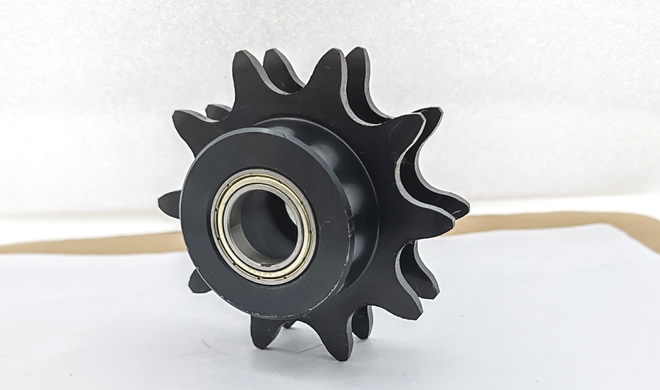
A duplex sprocket carries two rows of teeth on one body and runs with a duplex (two-strand) roller chain. Both strands share the transmitted load, raising the capacity of the chain drive without simply making a single strand larger. Where a simplex chain cannot meet the load within the available space, adding strands is the usual engineering answer. Duplex sprockets therefore suit high-load, long-centre-distance, and high-capacity drives.
1. What Problems Duplex Sprockets Solve
The core benefit is capacity within a constrained envelope. Instead of increasing chain size—which raises pitch, sprocket diameter, and spatial demand—a second strand is added to the same basic pitch. The result is a drive that carries more load while keeping the chain pitch and sprocket diameter essentially unchanged. This is valuable whenever the transmission must be upgraded but the machine layout cannot be enlarged.
2. High-Load Power Transmission
The typical application is transmitting substantial torque: conveyors, material-handling equipment, agricultural machinery, and general industrial drives where a simplex chain's allowable working load is insufficient. Two strands share the driving force and reduce the load carried by each.
One important qualification: capacity does not double. Standard rating tables assign a multi-strand factor of roughly 1.7 for duplex chain relative to simplex, because load is never shared perfectly evenly between the rows. Actual capacity also depends on tension distribution between strands, mounting accuracy, lubrication, and shock loading. The figure should be taken from the manufacturer's power-rating chart, not from multiplying the simplex value by two.
3. Limited Installation Space
Some machines are constrained by frame size: sprocket diameter cannot be increased significantly, and a larger-pitch simplex chain will not fit. Adding strands is then a common approach, because a duplex sprocket raises the effective number of load-carrying chains within a relatively small diameter.
The trade-off is width. A duplex sprocket is wider than a simplex one, and two strands add mass. Before specifying it, confirm the axial space available and check for interference among chain, sprocket, and bearing housing. The wider sprocket and heavier chain also increase the overhung load on the shaft, so bearing ratings and shaft deflection should be verified.
4. Continuous Conveying Equipment
Conveyors carrying heavy material, or running for long periods, place the drive under sustained tension. Where calculation shows a simplex chain is marginal, duplex chain and sprockets can raise the system's load capability and reduce the risk of premature wear or elongation.
If the priority is instead very high speed, low noise, and smooth running, chain drive itself should be reconsidered. Adding strands increases chain mass, the number of meshing points, and running noise. For clean, quiet, high-speed transport, a belt, timing belt, or geared drive may be the better answer.
5. Low-Speed, High-Torque Duty Versus High Speed
Chain drives are at their best transmitting high torque at low to medium speed. For slow, heavy machinery where a simplex chain would need to be extremely large, a duplex arrangement is a practical way to raise capacity without an oversized sprocket.
High speed is a different matter. Do not select duplex solely because the load is high. Check the chain's permissible speed, lubrication arrangement, pitch-line velocity, and dynamic loads. With too few teeth, chordal (polygonal) action produces speed fluctuation and noise; the effect grows with speed, so adequate tooth count and accurate alignment matter more as speed rises.
6. Matching Sprocket and Chain
A duplex sprocket cannot be used with an ordinary simplex chain. Number of strands, pitch, tooth profile, and chain designation must correspond. A duplex chain uses common pins and bushes at a standardized transverse pitch; two separate simplex chains run side by side cannot reproduce that shared load path and will not track evenly.
When quoting a replacement, giving only outside diameter or tooth count is a common source of mismatch. If the equipment already runs a duplex chain, identify the sprocket from the chain specification first, not by measuring the old sprocket alone.
7. Duplex Does Not Mean Higher Accuracy
A second strand increases capacity, not precision. If the sprockets are misaligned, the chain centre-lines do not coincide, or the two strands carry unequal loads, the result can be extra wear, impact, and uneven tooth engagement. Installation should therefore verify that both strands share load, that the sprocket is correctly positioned axially, and that chain tension is properly set and maintained.
8. Purchasing Advice
Confirm the mating chain specification first, then define the sprocket parameters. Key items are chain pitch, number of strands, tooth count, tooth profile, bore, hub dimensions, and mounting arrangement.
For heavy-duty drives, also provide transmitted power, speed, centre distance, and whether shock loads occur, so the duplex configuration can be checked against actual duty. When replacing a sprocket on equipment already fitted with duplex chain, keep sprocket and chain specifications consistent—avoid choosing an approximate match based only on diameter or tooth count.
9. Common Misconceptions
“A duplex sprocket has exactly twice the capacity of a simplex.” No—multi-strand ratings apply a factor below 2 because load sharing is imperfect.
“Two simplex chains can replace a duplex chain.” Not recommended. Duplex chain and sprocket are a matched system with common pins and defined strand spacing.
“The higher the load, the more a duplex sprocket should be used.” Not necessarily—speed, space, centre distance, lubrication, and actual transmitted power all matter.
“Duplex sprockets are more accurate than simplex.” No—the second strand raises capacity and does not improve transmission accuracy by itself.
FAQ
What is a duplex sprocket best used for?
Higher loads, higher torque, continuous operation, and cases where a simplex chain drive is no longer adequate.
How much more capacity does a duplex sprocket provide?
It generally carries more load, but not exactly twice as much; actual capacity depends on chain specification and working conditions.
Can a duplex sprocket run with a simplex chain?
Not as a proper duplex drive. It should be matched with the corresponding duplex chain.
Is a duplex sprocket suitable for high-speed drives?
It depends on chain specification, tooth count, pitch-line velocity, and lubrication. Noise and dynamic loads also need attention at high speed.
What parameters should be confirmed when buying a duplex sprocket?
Mainly chain specification and pitch, number of strands, tooth count, tooth profile, bore, hub dimensions, and mounting structure.
Copyright © 2016-2025 Forrun (Guangdong) Industrial Technology Co., Ltd All Rights Reserved.