- Contact Us
- -
- Payment
- -
- 中文版
Knowledge Center · 2026-11-11 09:33:44 · 10 hits
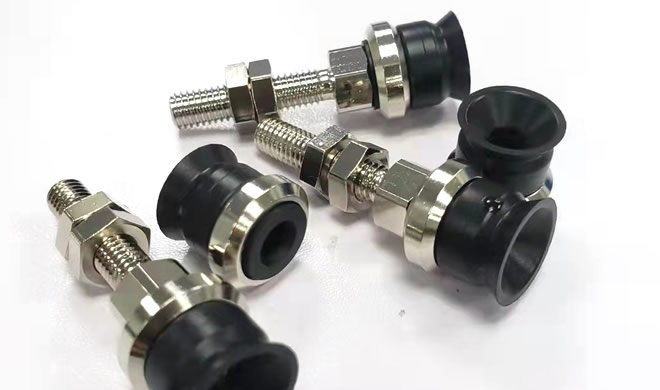
Flat vacuum cups are the standard choice for smooth, planar workpieces. Their large, flat sealing face gives good holding force and low profile, but it also makes them sensitive to surface condition, vacuum quality, and mounting geometry. The issues below cover most field failures.
1. Weak or Unstable Suction
The most common complaint is a drop in holding force, an insecure grip, or release under dynamic motion — usually traced to the sealing face or the vacuum source.
1.1 Rough or uneven workpiece surface. A flat cup demands flatness. Dents, burrs, or curvature cause local leakage, so vacuum cannot build.
1.2 Insufficient vacuum level. A clogged vacuum generator (ejector), leaking tubing, or a contaminated filter all lower the vacuum level and make gripping unstable.
1.3 Aged cup material. Rubber that has hardened and lost resilience no longer seals tightly, and air leaks past the lip.
2. Deformation and Poor Recovery
Flat cups run at high cycle rates under sustained compression, so they can take a permanent set that degrades the seal.
2.1 Excessive temperature. Beyond the material's temperature rating the compound softens or hardens, warping the cup's contact face.
2.2 Continuous, uninterrupted gripping. Duty with no rest interval causes stress fatigue in the elastomer and loss of flatness.
2.3 Undersized load capacity. When cup diameter and material do not match the workpiece weight, deformation and poor sealing both worsen.
3. Wear-Induced Seal Failure
With a large contact face in repeated contact with the workpiece, abrasion is the main failure source.
3.1 Sharp workpiece edges. They easily score the cup and damage the sealing lip.
3.2 Dusty environment. Dust trapped between cup and surface scratches the face and accelerates wear.
3.3 No scheduled replacement. A cup is a high-cycle consumable; overly long maintenance intervals let performance degrade unnoticed.
4. Vacuum Circuit and Mounting Issues
4.1 Leaking vacuum lines. Loose fittings, hardened tubing, and too many branches prevent a stable vacuum from being established.
4.2 Uneven mounting surface. An unflat mounting base loads the cup unevenly, leaving some areas of the lip unable to seat.
4.3 Missing anti-rotation feature. When handling a workpiece with a tendency to rotate, the cup can twist and break the seal. Fit an anti-rotation stop or use multiple cups.
5. Workpiece Material and Surface Effects
5.1 Oil film. Machined parts carrying oil film or coolant residue can slip off the cup instantly — clean or degrease the surface, or use an oil-resistant compound.
5.2 Porous materials. Paperboard, foam, and porous castings cannot hold a stable vacuum; use cups designed for porous media or add external vacuum compensation (a larger flow source or reservoir).
5.3 High-speed motion. In dynamic pick-and-place, insufficient vacuum response leaves the cup no time to build holding force before acceleration.
6. Quick Troubleshooting Matrix
| Symptom | Likely cause | Corrective action |
|---|---|---|
| Vacuum won't rise | Leak in line/fitting, clogged ejector, dirty filter | Check fittings, clean generator, replace filter |
| Holds, then slowly releases | Surface leak (roughness/burr) or aged lip | Improve surface, replace cup, add vacuum check valve |
| Slips instantly | Oil film / coolant, sharp edge, insufficient vacuum | Degrease, deburr, raise vacuum level |
| Cup warped or flattened | Over-temperature, continuous grip, wrong size | Match material to temp, add duty interval, upsize |
| Seal edge scored | Sharp edges, dust | Deburr, add cover/air blow-off, replace cup |
| Twists under load | No anti-rotation feature | Add anti-rotation stop or second cup |
7. Sizing and Material Notes
Theoretical holding force comes from the pressure difference across the cup's effective area:
F = ΔP × A → F_usable = (ΔP × A) / SF
where ΔP is the pressure difference (atmospheric minus vacuum), A the effective cup area, and SF a safety factor — typically ≥ 2 for horizontal lifting and ≥ 4 for vertical walls or high acceleration. With more than one cup, divide the load across cups and keep the same margin.
Cup material guide:
| Material | Strength | Temperature | Best for |
|---|---|---|---|
| NBR | Good oil resistance, general wear | −20 to 80 °C | Oily machined parts, general duty |
| Silicone | Wide temp, food-grade options | −60 to 200 °C | Food, medical, high/low temp |
| FKM | Chemical and heat resistant | −10 to 200 °C | Chemical, hot surfaces |
| PU | Excellent abrasion resistance | −20 to 60 °C | High-cycle, abrasive surfaces |
For curved, uneven, or height-varying surfaces, consider a bellows cup instead of a flat cup; its folds compensate for surface variation.
8. FAQ
Q: Why does my flat cup release under motion?
Usually insufficient vacuum response, an oil film, or no anti-rotation feature. Raise vacuum flow, clean the surface, and add a stop.
Q: How often should cups be replaced?
On a cycle-count or wear-based schedule, not only on failure — inspect the lip for hardening, scoring, and loss of flatness.
Q: Can flat cups grip porous materials?
Not reliably on their own; use porous-media cups, a higher-flow vacuum source, or vacuum compensation.
Q: Why is a safety factor needed beyond the calculated force?
Real conditions add acceleration, vibration, surface leakage, and aging; SF ≥ 2 (horizontal) / ≥ 4 (vertical) keeps the grip secure.
Q: When should I switch to a bellows cup?
When the surface is curved, uneven, or the pickup height varies — the folds absorb the difference that a flat cup cannot.
Copyright © 2016-2025 Forrun (Guangdong) Industrial Technology Co., Ltd All Rights Reserved.