- Contact Us
- -
- Payment
- -
- 中文版
Knowledge Center · 2026-11-05 09:28:50 · 13 hits
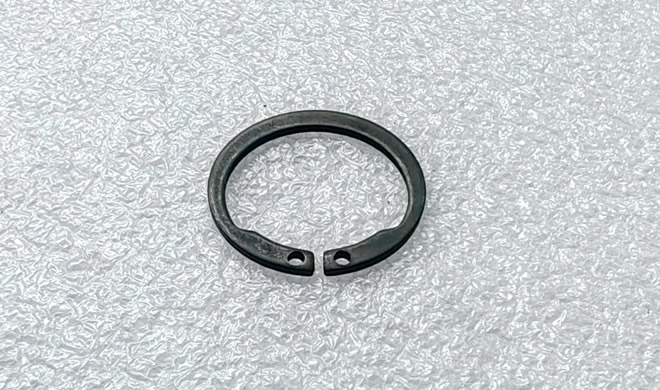
Internal retaining rings (internal circlips) are seated in a machined groove inside a bore to locate and axially retain a component. They are cheap and compact, but they only work when the ring, the groove, and the duty are matched. The mistakes below are the ones that most often show up in practice.
1. Sizing by Bore Diameter Alone
An internal ring's nominal size does correspond to the bore diameter, but what actually does the fixing is the groove, not the bore. If you size from the bore only and ignore the groove width and groove depth, the ring may not seat or may carry too little force once fitted. A ring chosen on bore alone can sit loose, protrude, or fail to grip the groove walls — so the bore size is only the starting point, never the whole specification.
2. Ignoring Groove Machining Tolerance
Standard rings specify the groove dimensions precisely. Insufficient groove depth lets the ring stand proud of the bore, blocking the mating part from seating. Excessive groove width reduces the ring's axial (thrust) capacity, so it can fail under vibration or shock. The groove is a designed feature with its own tolerance band; treating it as "any slot that fits" is a common source of隐性 failure.
Groove dimension vs. ring function (conceptual):
| Material | Temp range | Oil resistance | Chemical/acid resistance | Key property | Typical use |
|---|---|---|---|---|---|
| NR | −40 to 100 °C | Poor | Poor | High elasticity, abrasion | General, non-oily duty |
| NBR | −40 to 120 °C | Excellent | Moderate | Oil-resistant | Automotive, hydraulics, pneumatics |
| FKM | −20 to 250 °C | Excellent | Excellent | Heat + chemical | Chemical, petroleum, aggressive media |
| SiR (VMQ) | −60 to 250 °C | Poor–moderate | Moderate | Wide temp, hygienic | Food, medical, sanitary |
| PTFE | −200 to 260 °C | Excellent | Excellent (inert) | Low friction, inert | Precision, corrosive media |
| PU | −40 to 80 °C | Good | Moderate | High strength, abrasion | High-pressure hydraulics |
| Metal | Very high (material-dependent) | Excellent | Excellent | Extreme pressure/temp | Extreme-service, vacuum, high pressure |
3. Wrong Material or Strength Grade
Rings from different standards and grades differ sharply in material and elastic performance. Using a plain carbon-steel ring in a heavy-load or frequent-impact application invites plastic deformation, after which the ring can no longer locate or limit the part. Match the material and hardening to the load class — higher-grade (often through-hardened spring steel) rings for demanding duty.
4. Not Distinguishing Static from Vibration Duty
Under vibration or alternating load, an internal ring needs higher spring retention (elastic holding force). Selecting a standard static-duty ring for a vibrating assembly can let the ring gradually work loose, causing axial play (creep) or part damage. For vibration/shock service, specify rings rated for dynamic retention and verify the groove gives full support.
5. Assembly Method Not Matching the Standard
Many internal rings require specific assembly tools (circlip pliers) and a defined fitting direction. Wrong technique spreads the opening excessively or kinks the ring, creating local stress concentration and hurting long-term stability. Use the correct pliers, expand the ring only as far as needed, and seat it squarely in the groove.
6. Correct Selection Guidance
Start from the groove, not the bore: confirm groove diameter, width, and depth to the relevant standard before picking the ring.
Pick the standard family and check interchangeability: common internal-ring standards include GB/T 893 (China), DIN 472 / ISO 13337 (metric), and the corresponding ANSI series — dimensions are not universally interchangeable across families.
Match material to duty: plain carbon steel for light static use; hardened spring steel or phosphate-/plated grades for load, impact, or corrosion environments.
Apply a dynamic-duty margin: for vibration or shock, choose a ring with proven retention and a supported groove; do not rely on a static rating.
Fixture the groove, tool the fit: machine the groove to tolerance and use proper circlip pliers for assembly.
Quick selection checklist:
Bore diameter → nominal ring size (then verify against groove).
Groove diameter / width / depth within standard tolerance.
Material and grade vs. load and environment.
Static or vibration duty → retention requirement.
Correct pliers and assembly direction confirmed.
7. FAQ
Q: Can I choose an internal ring by bore size only? No — the groove dimensions decide retention; bore size is just the reference.
Q: What happens if the groove is too wide? The ring loses axial (thrust) capacity and can shift or fail under load.
Q: Are all internal rings interchangeable between standards? Not always. GB/T 893, DIN 472/ISO 13337, and ANSI have differing dimensions — confirm the family before substituting.
Q: Why does my ring loosen under vibration? Static-duty rings lack the retention needed for vibration; use a dynamic-rated ring and a fully supported groove.
Q: Which pliers do I need? Internal rings use pliers that expand the ring (reverse of external-ring pliers); use the correct tip type for the ring's lug holes.
Copyright © 2016-2025 Forrun (Guangdong) Industrial Technology Co., Ltd All Rights Reserved.