- Contact Us
- -
- Payment
- -
- 中文版
Knowledge Center · 2026-10-31 09:37:15 · 12 hits
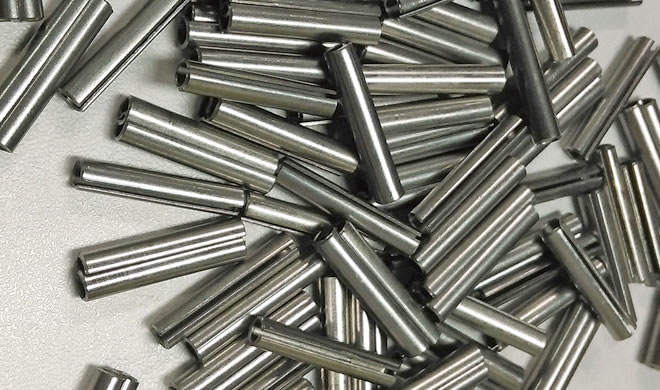
1. Basic Functions of Locating Pins
1.1 Ensuring position accuracy
In machining and assembly, locating pins define the relative position between components so the assembled structure meets the design intent. By constraining a part's degrees of freedom (DOF), they reduce installation error and raise the quality of the finished product. A part free in space has six DOF; pins and locating surfaces are arranged to remove exactly the ones that matter for the operation.
1.2 Improving work efficiency
Locating pins let an operator or a machine place a part quickly and repeatably, cutting manual adjustment time and speeding up production. On automated lines, pins working with robots enable efficient, continuous operation — the robot does not need to search for position because the pin establishes it.
2. Application Fields
2.1 Automotive manufacturing
During body welding, locating pins keep the panels correctly aligned to produce high-quality welds. In engine assembly, they assist the precise positioning of critical parts such as pistons and connecting rods.
2.2 Electronics production
The holes in a PCB and the leads of components must match precisely, and locating pins play a key role. In assembly, the placement of small electronic parts also relies on pins for initial fixing.
2.3 General machinery and tooling
Locating pins are equally standard in jigs and fixtures for machining, inspection gauges, and modular fixturing systems across general industry.
3. Pin Types and Features
| Type | Feature | Typical use |
|---|---|---|
| Straight (cylindrical) dowel pin | Standard round pin; simple, rigid, repeatable | General locating where tolerances are tight |
| Taper locating pin | Conical; easy to insert, good self-centering | High-precision locating, repeatable reset in fixed fixtures |
| Elastic (compliant) locating pin | Contains an elastic member allowing micro-adjustment | Larger-tolerance parts that still need stable locating; plastic-mold tooling |
| Diamond (relieved) pin | Round on one axis, flat on the other | Second locating pin in a 2-pin set to avoid over-constraint |
3.1 Taper locating pin. Suited to high-precision locating; it inserts easily and self-centers, so it is often used in fixed (one-time) clamping fixtures where accurate reset is required every cycle.
3.2 Elastic locating pin. Its elastic section tolerates a range of adjustment, fitting applications with larger tolerances that still demand stability — common in plastic-molding dies that must absorb size variation.
4. How to Choose a Locating Pin
4.1 Select material by environment
| Environment | Recommended material |
|---|---|
| General / dry | Hardened carbon or alloy steel |
| Corrosive / outdoor / washdown | Stainless steel (e.g., 304 / 316) |
| High wear | Case-hardened or nitrided steel |
| Non-marring contact | Brass, bronze, or polymer-tipped |
4.2 Consider the required precision
For very high-precision applications, choose a taper pin or another special shape. In most cases a standard straight locating pin already meets the requirement.
5. Maintenance Recommendations
5.1 Inspect wear regularly
After long use, pins wear and lose accuracy; periodic inspection and timely replacement are necessary.
5.2 Clean and lubricate
Keep the pin surface clean and apply suitable lubrication to extend service life — without letting lubricant attract chips that would defeat the locating accuracy.
6. Locating Principle in Fixtures (Round + Diamond Pin)
A common mistake is using two identical round pins to locate a part on a plane. Both pins then try to fix the same translational DOF along the line joining their centers, over-constraining the part and forcing either clamping stress or mislocation. The standard convention is a round pin plus a diamond (relieved) pin: the round pin fixes two in-plane DOF, and the diamond pin — flat on one side — fixes only the remaining one. Together they constrain the four in-plane DOF without redundancy. This is one expression of the broader 3-2-1 locating principle, which removes all six DOF with the minimum necessary locators.
7. FAQ
Q: Are locating pins and dowel pins the same? "Locating pin" is the general term; a "dowel pin" usually means the standard straight cylindrical pin. Taper, elastic, and diamond pins are locating pins but not dowel pins in the strict sense.
Q: Why use a diamond pin instead of a second round pin? To avoid over-constraint: the diamond profile removes only one translational DOF, preventing clamping stress and locating error.
Q: Can a locating pin also clamp the part? Locating and clamping are separate functions. A pin should locate; a separate clamp should hold. Mixing them risks losing accuracy.
Q: How often should pins be replaced? On a wear-based schedule tied to cycle count and inspection; replace when diameter wear or scoring exceeds the part's tolerance budget.
Copyright © 2016-2025 Forrun (Guangdong) Industrial Technology Co., Ltd All Rights Reserved.