- Contact Us
- -
- Payment
- -
- 中文版
Knowledge Center · 2026-10-29 09:40:22 · 6 hits
1. Common Failure Modes
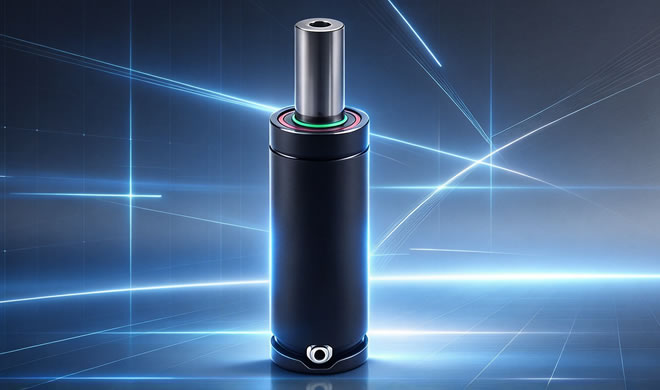
Gas springs — nitrogen gas springs in die and automation applications — work as high-force elastic elements in stamping dies, automated clamping, and other high-cycle duties. (Distinct from the lift-support gas struts used for lids and flaps, these deliver much higher, repeatable force.) Used incorrectly or under-maintained, they develop the following characteristic failures:
1.1 Internal pressure loss → insufficient stroke. Gas escapes through microcracks, damaged seals, or a loose charging valve, causing an abrupt drop in return force and the inability to reach the set stroke.
1.2 Seal wear and aging. Sustained high-frequency compression plus heat hardens and cracks the seals, which in turn causes gas bypass, sticking, and unstable rebound.
1.3 Piston-rod scoring or bending. Typically from off-center loading, misalignment, or foreign-object damage. The rod runs rough, friction climbs, and in the worst case the spring seizes.
1.4 Cylinder fatigue cracking. Over-stroke, over-pressure, or overload initiate fatigue cracks that eventually lead to failure and sudden blowdown.
1.5 Sluggish or sticking action. Driven by internal contamination, insufficient lubrication, or eccentric load, it shows up as delayed rebound and an unstable press cycle.
2. Main Factors That Cause Damage
2.1 Exceeding rated stroke or pressure. The single most common cause — it triggers cylinder fatigue and rod overload.
2.2 Excessive impact load. Equipment shocks or unreasonable die clearance spike the instantaneous load and damage the internals.
2.3 Eccentric mounting or inadequate guidance. Uneven force accelerates rod bending and seal wear.
2.4 Prolonged high temperature or oil contamination. Heat ages the seals faster; oil, lubricant, or metal powder entering the system wears the valve and causes sluggishness.
2.5 Missing maintenance. Without periodic checks of pressure, stroke, and seal condition, minor damage escalates into serious failure.
3. Preventive Measures
3.1 Control stroke and load strictly. Set the maximum stroke and working pressure from the manufacturer's data; avoid overpressure and impact.
3.2 Ensure accurate mounting and balanced force. Keep die guidance sound, avoid eccentric load, and let the piston rod move in a straight line.
3.3 Reduce instantaneous impact through die design. Add buffer structures and improve the slide velocity profile to lower the shock on the spring.
3.4 Keep the environment clean. Stop iron chips and dust from entering the cylinder or touching the rod; fit a protective boot where needed.
3.5 Inspect and maintain on a schedule. Check pressure at every die change, inspect seals periodically, and monitor rebound speed and stroke stability.
4. Failure-Mode Reference Table
| Failure mode | Typical symptom | Common root cause |
|---|---|---|
| Internal pressure loss | Sudden force drop, short stroke | Microcrack, seal damage, loose valve |
| Seal wear / aging | Gas bypass, sticking, unstable rebound | High-cycle compression + heat; hardened/cracked seal |
| Rod scoring / bending | Rough travel, rising friction, seizure | Eccentric load, misalignment, foreign object |
| Cylinder fatigue crack | Cracks → sudden blowdown | Over-stroke, over-pressure, overload |
| Sluggish / sticking | Delayed rebound, unstable cycle | Contamination, poor lube, eccentric load |
5. Maintenance Checklist
At every die change: verify return force and full stroke; look for external oil film (seal weep), rod scoring, and body cracks.
Weekly / monthly: check charging-valve tightness, measure stroke under load, confirm no side load is present.
Annual or per cycle count: replace seals at the manufacturer's interval and re-qualify the charged pressure.
Storage: keep units in their as-received condition, away from extreme temperatures and corrosive media.
6. Gas Spring vs. Mechanical Springs — Selection Comparison
When a gas spring is not the best fit, disc springs (Belleville washers) or polyurethane (elastomer) springs are the usual alternatives. The table below helps choose:
| Criterion | Gas spring (nitrogen) | Disc spring (Belleville) | Polyurethane spring |
|---|---|---|---|
| Force–stroke curve | Near-constant force over long stroke | High force, very small deflection; stackable for constant force | Progressive (rising) force, short travel |
| Force range | Medium–very high, linearly scalable | Very high in compact space | Low–medium |
| Stroke / deflection | Large | Millimeter-scale | Small–moderate |
| Space requirement | Needs axial length | Very thin, radial-compact | Compact |
| Cycle life | High, but seal-limited | Very high, robust | Lower; degrades with heat/ozone |
| In-use adjustability | Fixed (charged) | Adjust by stacking | Fixed by geometry |
| Environmental tolerance | Sensitive to heat & over-pressure | Tolerant of heat, dirt | Sensitive to oil, ozone, UV, temp |
| Damping / isolation | Slight internal | None (metal-on-metal) | Excellent shock absorption |
| Failure style | Sudden blowdown if cracked | Gradual | Creep / tear |
| Typical use | Long-stroke die cushion, smooth clamping | High preload in tight space, backstop/overload |
How to choose. Pick a gas spring when you need smooth, near-constant force across a long stroke — die cushions, automated clamping, and lift assists. Choose disc springs when space is tight and you need very high preload or an overload/backstop element with long, predictable life. Reach for polyurethane when the priority is absorbing impact, cutting noise, or cushioning short travels, rather than holding a precise, constant force.
7. FAQ
Q: Can a leaking gas spring be recharged? Some die gas springs are field-rechargeable through the charging valve; many are sealed units. Follow the manufacturer — and never attempt to recharge a cracked or blown-down spring.
Q: Is oil on the rod normal? A slight film is normal; a heavy film or weeping indicates seal seepage — monitor and replace before it worsens.
Q: How do I avoid eccentric load? Use guide posts or bushings, align the spring axis with the applied load, and keep running clearance minimal.
Q: What ages the seals fastest? Heat combined with high cycle count. Stay within the temperature rating and the rated pressure.
Q: When should I avoid a gas spring and use a disc or polyurethane spring instead? Use a disc spring when you need very high, compact preload or an overload stop; use polyurethane when shock absorption and noise control matter more than a constant force. See Section 6.
Copyright © 2016-2025 Forrun (Guangdong) Industrial Technology Co., Ltd All Rights Reserved.