- Contact Us
- -
- Payment
- -
- 中文版
Knowledge Center · 2026-11-06 10:28:33 · 10 hits
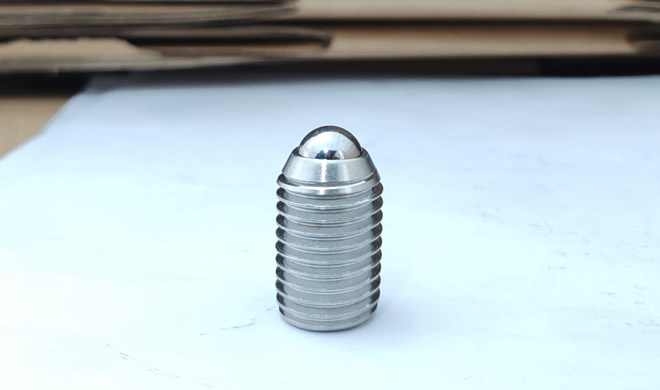
A spring-loaded ball plunger (often called a ball plunger or spring plunger) uses an internal spring to hold a steel ball against a workpiece or a locating surface. The ball retracts under load and returns automatically when the load clears, giving repeatable positioning with a degree of compliance. (Do not confuse it with a pull-type indexing plunger — the ball plunger here is a passive, spring-backed detent, not a plunger you pull to disengage.)
1. Main Functions
Precision positioning. The spring-backed ball snaps the workpiece into a repeatable position, with repeatability commonly around ±0.01 mm when properly seated.
Workpiece fixturing and limiting. As an auxiliary locator, the plunger provides positioning and end-stop action during assembly, transfer, and machining.
Reduced clamping pressure. The spring gives a measured amount of compliance during locating, cushioning contact and reducing surface damage to the workpiece.
2. Typical Applications in Automation
Conveyor and transfer lines. Used at the end of a belt to stop the workpiece accurately at a machining or inspection station.
CNC machining and fixturing. Paired with fixtures for fast workpiece clamping, raising changeover efficiency.
Robotic assembly lines. Provide precise pre-alignment before a gripper picks or places a part, improving assembly accuracy.
Inspection and test stations. Hold the measured part in a consistent position every cycle, cutting measurement error.
3. Selection and Installation
3.1 Selection basis
Load capacity: choose spring force to suit the workpiece weight and the force needed to retain it without chattering.
Precision grade: for precision machining, specify a high-grade ball (e.g., G10); lower grades suffice for coarse locating.
Mounting type: threaded, press-in, or flanged.
Mounting-type comparison:
| ype | How it fits | Advantages | Watch-outs |
|---|---|---|---|
| Threaded | Screwed into a tapped hole | Adjustable depth, easy to replace | Needs thread clearance; torque during fitting |
| Press-in | Pressed into a clear bore | Compact, no thread needed | Bore tolerance critical; hard to remove |
| Flanged | Held by a flange + screw | Strong axial retention, easy fit | Needs flange clearance on the surface |
Selection parameter guide:
| Factor | Choose… | Reason |
|---|---|---|
| Light workpiece, gentle detent | Low spring force | Avoids excessive push-out force |
| Heavy / high-vibration | Higher spring force, flanged or threaded | Stays seated under load |
| Precision locating | G10 (or finer) ball, hardened | Repeatability and wear |
| Corrosive / washdown | Stainless body and ball | Prevents rust and seizure |
| High wear | Ceramic or hardened ball | Extends life |
3.2 Installation advice
Keep the perpendicularity / center-alignment error between the locating hole and the plunger within ≤ 0.02 mm.
After fitting, ensure the ball can extend and retract freely, with no side load interfering with its travel.
3.3 Maintenance
Periodically clear chips and debris to prevent sticking.
Apply a light grease to extend the life of the spring and the ball.
4. Ways to Improve Plunger Performance
Use wear-resistant balls — stainless steel or ceramic — where abrasion is high.
For high-precision operations, adopt a dual-plunger arrangement to raise repeatability.
In dusty environments, fit a protective cover or sealing boot to keep contaminants out.
5. FAQ
Q: Is a ball plunger the same as an indexing plunger? No. A ball plunger is a passive spring-backed detent; an indexing plunger has a pull-knob that retracts the pin/ball for deliberate disengagement.
Q: How accurate is positioning with a ball plunger? Around ±0.01 mm repeatability in a well-seated installation; the actual accuracy also depends on hole perpendicularity and ball grade.
Q: How do I choose the spring force? Match it to the workpiece weight and the retention needed — too soft lets the part chatter, too hard makes insertion difficult and can mark the surface.
Q: Can ball plungers be used in dusty conditions? Yes, but fit a cover or boot and keep them greased; otherwise chips cause sticking.
Q: Which ball grade do I need? G10 or finer for precision locating; coarser grades are fine for general detent use.
Copyright © 2016-2025 Forrun (Guangdong) Industrial Technology Co., Ltd All Rights Reserved.