- Contact Us
- -
- Payment
- -
- 中文版
Knowledge Center · 2026-08-25 09:52:42 · 244 hits
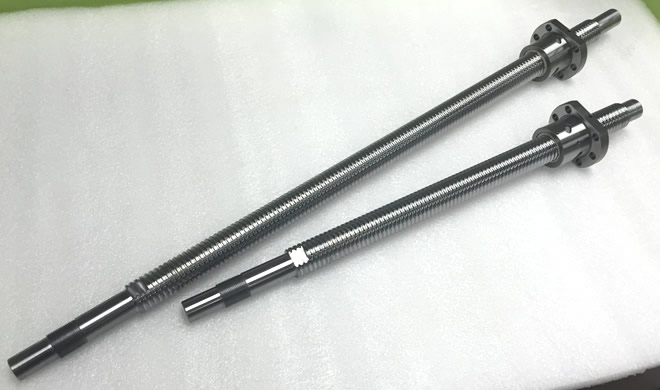
1. The Necessity of Ball Screw Preload
Ball screws transmit linear motion and mechanical load through circulating steel balls between the screw shaft and nut assembly. Excessive axial clearance inside the screw pair will cause micro backlash and idle travel during direction switching or axial load fluctuation. This inherent clearance severely compromises positioning accuracy, especially for automated equipment with frequent forward and reverse reciprocating motion.
Preload eliminates redundant axial backlash by maintaining continuous contact pressure between steel balls and raceways. It stabilizes the transmission state during direction reversal, ensures immediate mechanical response, and fundamentally improves the motion consistency of high-precision linear transmission systems.
2. Key Performance Improvements Brought by Preload
Enhanced Axial Rigidity
Preload effectively restricts elastic displacement of the ball screw pair under axial load. It significantly improves structural rigidity, making the screw system capable of sustaining dynamic loads with minimal deformation, which meets the high precision and repeat-positioning requirements of sophisticated automation mechanisms.
Elimination of Backlash
Unpreloaded ball screws require eliminating internal clearance first before driving loads during direction switching, resulting in obvious idle travel and positioning delay. Reasonable preload removes axial backlash completely, achieving zero-backlash transmission and precise synchronous motion output.
Improved Operational Stability
Preload keeps steel balls in continuous, tight contact with raceways during load changes and frequent direction switching. It avoids intermittent contact and jittery motion, ensuring smooth, steady and consistent linear movement throughout the full stroke.
3. Is Higher Preload Always Better?
Excessively high preload is detrimental to ball screw operation. Increased preload raises contact pressure between steel balls and raceways, which leads to higher running resistance, intensified friction heat generation and greater motor driving torque requirements.
For high-speed ball screw applications, over-preloading causes severe temperature rise, accelerates surface wear of raceways and rolling elements, and greatly shortens the service life of the transmission pair. Ball screw preload design is essentially a balanced optimization among rigidity, positioning accuracy, frictional resistance and service lifespan.
4. Applicable Scenarios for Preloaded Ball Screws
Preload is essential for high-precision and high-rigidity equipment, including precision positioning platforms, CNC machine tools, automated processing equipment and high-end FA production machinery. These scenarios demand zero backlash, ultra-high repeatability and stable dynamic performance.
In contrast, low-speed, low-precision linear motion mechanisms with loose backlash tolerance do not require high-level preload. The preload scheme must be customized according to actual working conditions, including load magnitude, operating speed, acceleration and cyclic frequency. High-speed equipment shall never adopt excessive preload merely for rigidity improvement, so as to avoid thermal failure and premature component aging.
5. Common Industry Misconceptions
A typical misconception is that higher preload equals higher positioning accuracy. In practice, excessive preload generates excessive friction and heat accumulation, which deteriorates high-speed motion stability and even causes positioning deviation.
Another prevalent mistake is focusing solely on screw pair preload while ignoring peripheral installation accuracy. Final positioning performance is comprehensively determined by bearing support rigidity, mounting coaxiality and coupling operating status. Unqualified assembly will offset the accuracy advantages of preloaded ball screws.
FAQ
Q: What is the core function of ball screw preload?
A: It eliminates axial backlash, improves system axial rigidity, and enhances positioning accuracy and motion stability.
Q: Is greater preload always preferable?
A: No. Excessive preload increases friction, heat generation and driving load, and reduces the overall service life of ball screws.
Q: Are high-speed ball screws suitable for heavy preload?
A: Heavy preload is not recommended. Excessive preload causes severe temperature rise during high-speed operation. Preload level must match the actual speed and working conditions.
Q: Can non-preloaded ball screws be used normally?
A: They are applicable for low-precision scenarios with low backlash requirements. Specific feasibility depends on screw structure and application standards.
Q: Does ball screw preload affect motor selection?
A: Yes. Preload increases operational resistance and required driving torque. The additional load caused by preload must be included in motor parameter calculation and model selection.
Copyright © 2016-2025 Forrun (Guangdong) Industrial Technology Co., Ltd All Rights Reserved.