- Contact Us
- -
- Payment
- -
- 中文版
Knowledge Center · 2026-08-31 10:19:03 · 211 hits
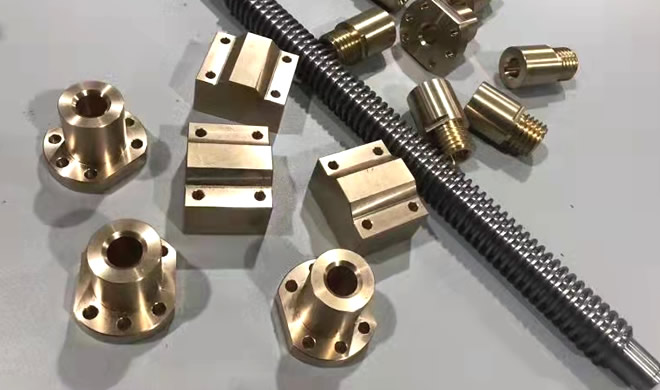
A trapezoidal lead‑screw assembly mainly consists of a trapezoidal‑thread screw shaft and a matched nut. Compared with standard triangular threads, trapezoidal threads feature wider crests and roots, delivering larger load‑bearing contact areas, which makes them well‑suited for axial load support and motion transmission. As the screw shaft rotates, the nut is restrained by thread geometry and prevented from rotating synchronously; instead, it travels axially along the screw. Reversing screw rotation changes the linear travel direction of the nut. Thanks to high load capacity, robust durability and convenient manufacturing & maintenance, trapezoidal lead screws are widely deployed in mechanical transmission applications where high efficiency and ultra‑precision positioning are not primary requirements.
Fundamentally, trapezoidal lead screws convert rotary motion into linear displacement via helical thread geometry. One full helical turn corresponds to one lead of axial travel. Theoretically, one complete rotation of the screw drives the nut forward by exactly one lead. Continuous screw rotation generates continuous linear motion of the nut.
The lead defines axial displacement per full revolution, directly determining transmission speed and motion resolution. Under identical rotational speed, a larger lead yields higher nut travel speed, yet demands greater driving torque and may weaken self‑locking performance.
Trapezoidal thread profiles provide substantial effective contact surfaces, enabling axial loads to be evenly transferred across mating thread faces to the nut body. Material combinations can be flexibly configured according to operating conditions: metal screw shafts pair with either metal or engineering‑plastic nuts. This structural design performs reliably within low‑speed, heavy‑duty and reciprocating mechanisms.
It should be noted that trapezoidal lead screws operate on sliding‑friction transmission. Sliding contact between screw and nut results in lower transmission efficiency relative to ball screws, accompanied by measurable friction heat and progressive component wear during operation.
Self‑locking is a notable characteristic of properly configured trapezoidal lead screws. When thread helix angle and friction coefficient satisfy specific conditions, axial load applied to the nut cannot back‑drive the screw spontaneously. This property makes trapezoidal lead screws ideal for lifting, clamping and adjustment mechanisms requiring position holding.
Nevertheless, self‑locking is not an inherent guarantee for every trapezoidal lead screw. Increased lead or varied surface‑friction conditions may degrade or eliminate self‑locking performance. For applications with strict anti‑back‑driving requirements, engineers cannot rely merely on component type. Verification based on actual thread parameters and field operating conditions is mandatory.
A widespread misconception regards trapezoidal lead screws and ball screws as differing only in thread profile. In fact, their core distinction lies in transmission principle: trapezoidal lead screws transmit force through sliding friction between thread surfaces, while ball screws utilize rolling elements to bear loads. This fundamental difference creates obvious gaps in efficiency, friction loss, heat generation and applicable scenarios.
Another misunderstanding assumes larger lead always delivers superior overall performance. Although a larger lead improves linear velocity at given motor speed, it imposes higher driving‑torque requirements and compromises self‑locking and positioning behaviour. Lead selection must match real‑world application demands.
What are typical application scenarios for trapezoidal lead screws?
They are commonly applied in lifting, clamping, adjusting, positioning and low‑speed heavy‑load linear transmission mechanisms.
How do trapezoidal lead screws produce linear motion?
Through thread engagement between rotating screw shaft and restrained nut, rotary input is converted into axial linear displacement of the nut.
Do trapezoidal lead screws have self‑locking function?
Self‑locking can be achieved under certain working conditions. Actual performance depends on lead, helix angle and interfacial friction status.
What are the main differences between trapezoidal lead screws and ball screws?
Trapezoidal lead screws adopt sliding‑friction transmission with simple construction and potential self‑locking capability. Ball screws work via rolling friction and deliver higher transmission efficiency and superior dynamic performance.
Is a larger lead always better for trapezoidal lead screws?
Not necessarily. Lead shall be selected comprehensively considering target linear speed, applied load, driving torque limit, self‑locking requirements and positioning specifications.
Copyright © 2016-2025 Forrun (Guangdong) Industrial Technology Co., Ltd All Rights Reserved.